
Kanka, Notion, a Binder or Talehaven? Choosing the Right Tool for Your RPG Campaign
The Talehaven team9 min read
The same question appears on forums and Discord servers every few weeks:
What should I use to manage my campaign?
The answers are usually one of two things.
Use whatever works for you.
True, but not very helpful.
Or a list of twenty tools with star ratings where, by remarkable coincidence, the author's preferred tool wins.
Let us try something else.
Not "which tool is best?"
Instead:
What was each one built to do?
That is the difference that matters on Sunday evening when a player asks for the surname of an innkeeper from five sessions ago.
One disclosure before we start: we build Talehaven.
That is exactly why this comparison includes situations where I would recommend something else.
Paper, notebooks and binders
The oldest solution is still one of the best.
No setup.
No login.
No updates that suddenly change a workflow in the middle of a campaign.
Paper does not have server downtime.
It also has one quality apps struggle to replicate: it does not demand attention at the table. There are no notifications and no temptation to keep adjusting the formatting.
Paper is excellent when you run one campaign, know most of it by memory and your notes fit into a manageable number of pages.
Or when handwriting is simply part of the pleasure.
It starts to hurt after twenty sessions, when you are looking for one surname across three notebooks while a player asks who the party promised a favour six months ago.
You cannot search a binder.
You cannot easily share one page with the players.
Tea remains a serious backup strategy problem.
Everything else works remarkably well.
Notion, OneNote and general-purpose documents
Think of these as blank pages with superpowers.
You can build almost anything.
An NPC database.
Relationship tables.
Session calendars.
Custom dashboards.
The exact campaign management system you have in your head.
That freedom is both the strength and the cost.
You need to design the structure yourself.
Before adding the first NPC, you decide which fields the NPC needs. Then how the NPC connects to a location. Then how to show only living NPCs in a campaign view.
Some people love this work.
I have seen Notion workspaces better designed than dedicated RPG apps.
I have also seen people spend three evenings building an immaculate workspace and zero evenings preparing the actual adventure.
Use this route when you enjoy designing your own system, want maximum flexibility and perhaps already keep the rest of your life in the same tool.
It starts hurting when Saturday's session is approaching and you are spending the third evening adjusting a character template.
Kanka, World Anvil and worldbuilding platforms
These are tools built around the world itself.
Kanka, World Anvil and similar platforms are good products, and they solve a problem Talehaven does not try to solve in exactly the same way.
If your setting is a long-term project with dynasties, religions, historical wars, family trees, calendars and material that survives across several campaigns, a dedicated worldbuilding platform makes a lot of sense.
The world is the primary object.
The campaign may simply be one story happening inside it.
That is perfect when you have been developing the same setting for years and want to describe it properly.
It can feel like more than you need when you are running an existing setting and only want an inn, seven guests and several scenes ready for Saturday.
Where Talehaven fits
Talehaven was built around a different question:
What does a GM need during the session when the players just went somewhere they were not expected to go?
That is why the campaign structure is already there, but you do not have to fill it.
An NPC with three sentences is still an NPC.
A location without a map is still a location.
Campaign materials sit next to one another.
Locations can point to people the party may meet there.
GM secrets are separate from what players see.
Maps, notes, items, timelines and session scheduling can live in the context of the same campaign.
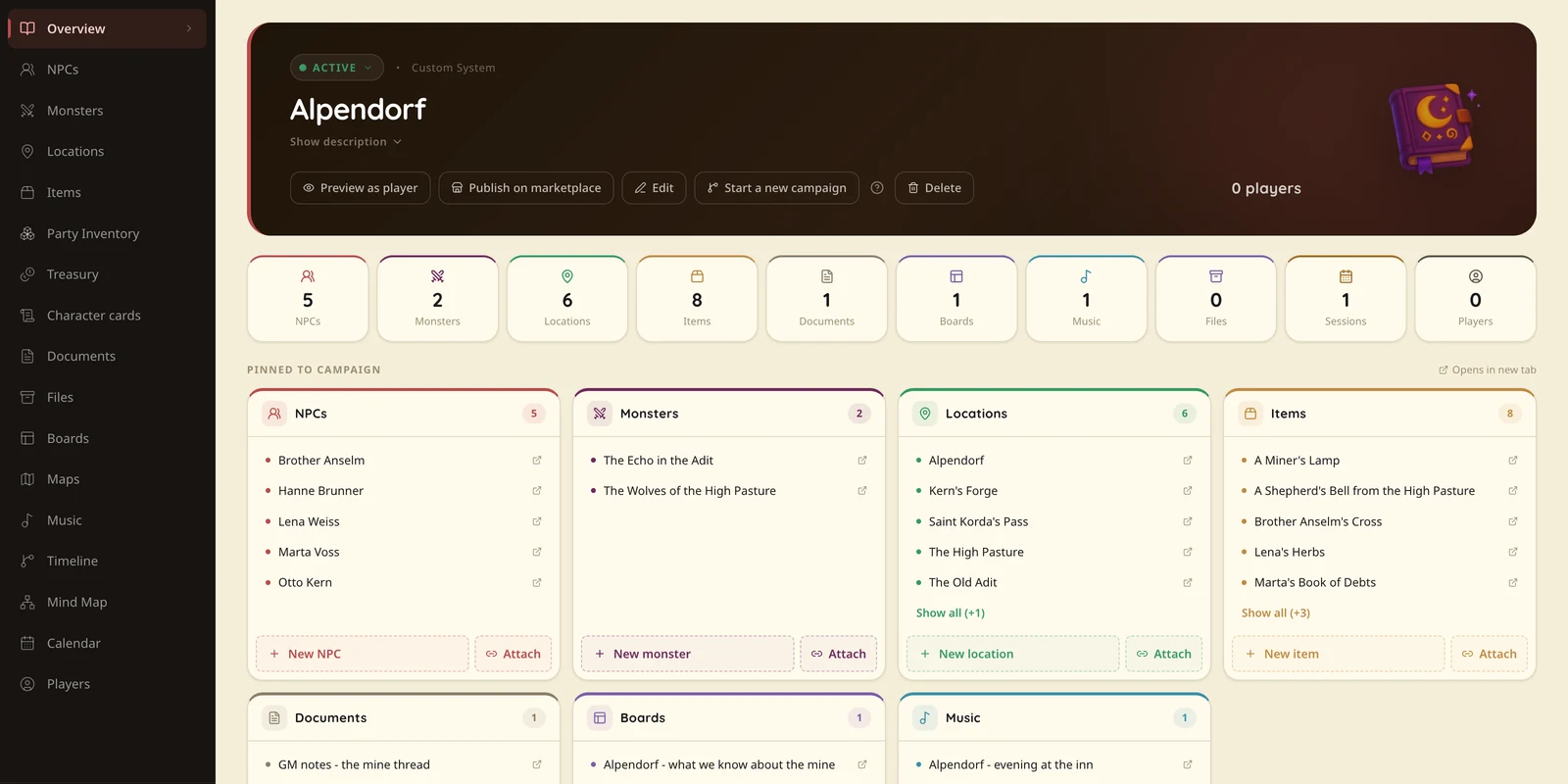
The aim is not to create a two-hundred-page encyclopedia.
If that is what you want, dedicated worldbuilding tools are usually a better fit.
When not to choose Talehaven
When you are building a world encyclopedia
Dynasties, languages, religions, three hundred years of political maps.
Worldbuilding platforms go deeper here.
When you love designing your own system
If creating databases, views and formulas is part of the fun, Notion offers a level of freedom Talehaven deliberately does not try to match.
When the campaign fits in a notebook
One adventure, four players and twenty pages of notes.
You may not need an account anywhere.
When your current method simply works
This is the most important one.
Changing tools in the middle of a campaign costs time.
If your current setup is not causing problems, migrating everything because somebody online likes another app is rarely worth it.
How to choose without reading another ranking
Ask yourself three questions.
What did you last search for during a session, and how long did it take to find?
How much time did you spend this month preparing the adventure versus organising the notes?
What happens to these materials if you return to the campaign after a year-long break?
The answers usually tell you more than feature comparison tables.
If you constantly lose information during play, you need something searchable.
If you spend more time organising than preparing, you probably need more built-in structure.
If the world has become a project larger than the campaign itself, you may need a worldbuilding platform.
You also do not need one tool for everything.
Plenty of GMs keep their setting in one place and the active campaign somewhere else.
That is completely reasonable.
The best campaign tool is not the one with the longest feature list.
It is the one you can stop thinking about once the session begins.
If what we are building is useful to you, you can buy us a coffee.
Support on Ko-fiKeep one campaign in one place
Documents, NPCs, locations, maps and music next to each other - so the session does not start with a search.
Try Talehaven