
Do Players Really Need to Know Your World's Lore?
The Talehaven team14 min read
You spent three evenings working out the history of a kingdom.
You know why the old dynasty collapsed, which noble family funded the rebellion, why two churches hate each other and what really happened at the Battle of Blackwater Ford one hundred and sixty years ago.
The players arrive.
Twenty minutes into the session, one of them asks:
Wait. Who is the king again?
This is not a failure of your worldbuilding.
It is usually a sign that the Game Master and the players need completely different amounts of information.
A GM may need to know why the world works the way it does. Players mostly need to know enough to make a decision right now.
That difference matters.
Lore is useful when it changes something at the table
There is nothing wrong with writing a lot of lore. Building a world can be part of the fun of being a GM.
The problem starts when we assume that because something was enjoyable to create, the players must learn it before the campaign can work.
Before sharing a piece of background information, ask one question:
What can the players do differently because they know this?
"The city was founded in 843 by King Albrecht II" may be interesting.
"The western gate is still controlled by Albrecht's descendants, and they refuse entry to anyone carrying the duke's colours" gives the players something to work with.
Both are lore.
Only one immediately affects play.
Players remember situations better than lectures
Imagine starting a campaign with a two-page introduction about tension between two noble houses.
Names. Dates. Marriages. Betrayals. Old borders.
Some players will read it carefully. Some will skim it. Some will remember that two families dislike each other and forget everything else.
Now introduce the same conflict during play.
The party arrives at a bridge. Two groups of armed men are arguing over who has the right to collect the toll. One wears the black stag of House Veller. The other wears the silver tower of House Dorn.
Both claim the law is on their side.
The players need to choose who to believe.
Suddenly the conflict matters.
They will probably remember the names because those names cost them money, created an enemy or opened a route through the region.
Lore sticks much better when it arrives attached to a person, place, problem or decision.
Separate what everyone knows from what only you need to know
A useful world can have several layers of knowledge.
Common knowledge
Things an ordinary person living in the setting would know.
Who rules the region. What the main religion is. Which war ended recently. Why nobody travels through the northern forest after dark.
This usually needs very little space.
Relevant knowledge
Things that matter because of who the characters are or where the campaign is happening.
A dwarf from a particular hold may know why a nearby clan is considered dishonourable. A city guard will know which district belongs to which gang. A priest may recognize a forbidden symbol that means nothing to the rest of the party.
This is the best place for character-specific information.
GM knowledge
Everything underneath.
The war was actually started by someone else. The saint never existed. The abandoned mine is connected to the royal family. The friendly merchant has been financing both sides.
Players do not need this information until they have a way to discover it.
Keeping these layers separate makes worldbuilding much easier to use.
Do not explain a faction before the players meet someone from it
A faction becomes real when it has a face.
Instead of explaining that the Guild of Ash controls trade along the river, introduce a guild factor who refuses to unload the party's cargo until an old debt is settled.
Instead of describing a religious schism, let two priests disagree in front of the characters about whether a dead man may be buried inside the city walls.
Instead of writing three paragraphs about a war, show a village where half the houses are still empty because the people who lived there never came back.
Players can learn the larger story later.
First give them something they can see.
Give players the amount of context their decision requires
If the party is choosing between two roads, they do not need the complete history of the region.
They need to know:
- one road is shorter but passes through land controlled by a hostile baron,
- the other takes an extra day and crosses an old battlefield,
- the caravan they are chasing is already several hours ahead.
That is enough to make the decision meaningful.
If the battlefield becomes important later, add more.
That is one of the simplest ways to stop worldbuilding from turning into homework. Reveal the world at the speed the campaign actually reaches it.
A short handout can be useful. A textbook usually is not
There are campaigns where players genuinely need some background before the first session.
Political intrigue. A game about members of the same noble court. A campaign starting in the middle of a civil war.
In those cases, give them something short enough to use.
A useful player handout might contain:
- five things everybody knows,
- three important names,
- two current conflicts,
- one map,
- a few questions connected directly to the characters.
That is much easier to remember than ten pages of setting history.
You can always make more material available for the player who wants it.
The important distinction is between **available** and **required**.
Let curious players dig deeper
Not every player wants the same amount of lore.
One person will ask how local inheritance law works. Another wants to know where the nearest tavern is.
Both are playing correctly.
Make deeper material available without requiring everybody to consume it.
This is also why I like keeping world information in separate pieces rather than one huge campaign document. A location can contain its local history. An NPC can carry the political conflict that matters to them. A document can hold the long version of an old war for the player who actually wants to read it.
In Talehaven, those pieces can live inside the same campaign without forcing everyone to open all of them.
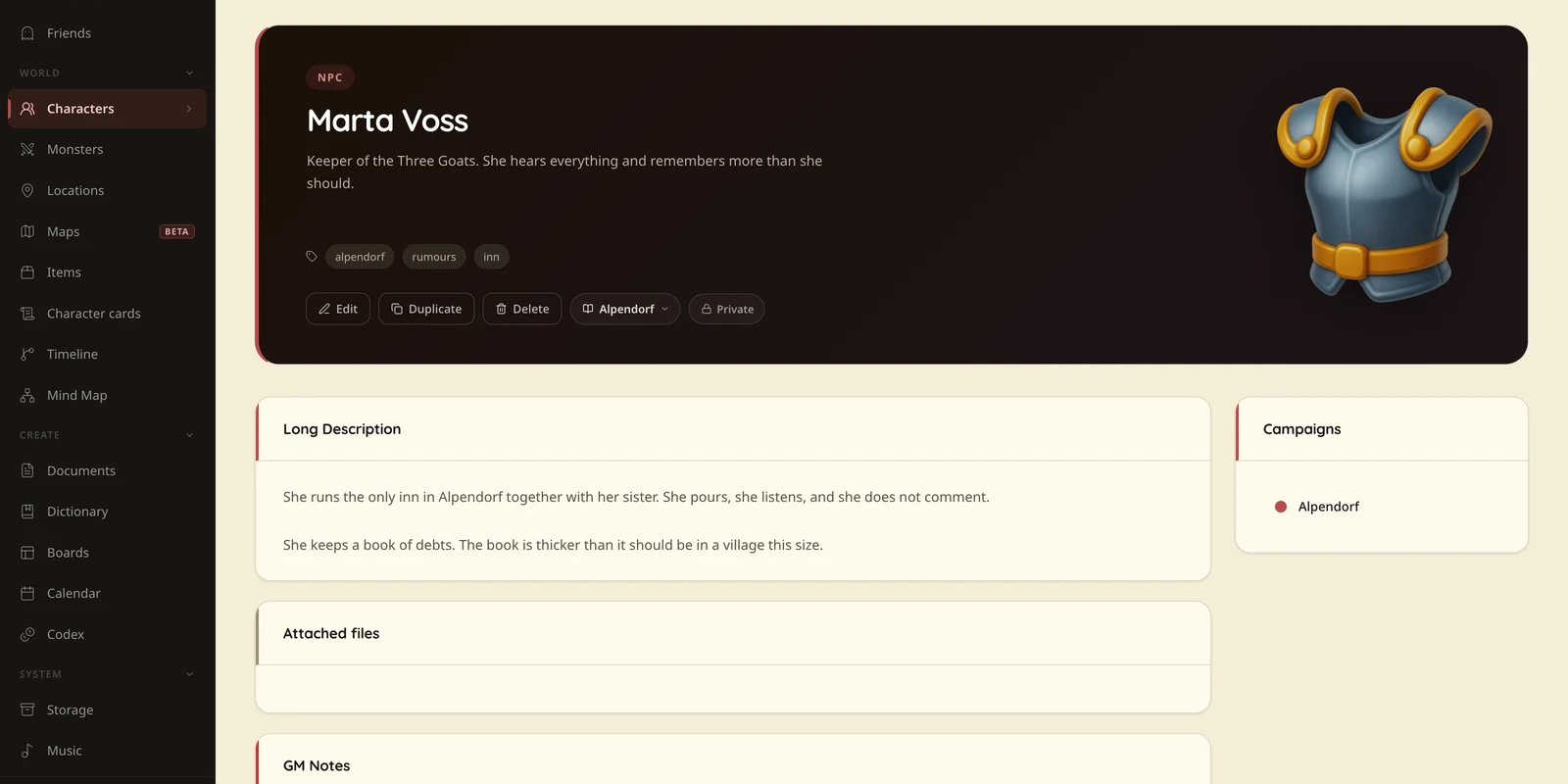
The tool is secondary. The principle matters more: let people reach additional context when they need it.
Repeat important information without feeling guilty
The characters may have lived in this world for thirty years.
The players heard the duke's name once, three weeks ago, at 11:40 p.m.
Those are not the same thing.
If something matters, repeat it.
The guards wear the silver tower of House Dorn, the same family whose men stopped you at the bridge.
That sentence is not treating your players like they are inattentive. It is restoring information their characters would reasonably remember.
Campaigns happen across weeks and months. Human memory is not a campaign database.
Make lore answer questions instead of creating an exam
Good worldbuilding makes players curious.
Why does nobody use the old road?
Why did the innkeeper stop talking when we mentioned the mine?
Why does the priest hate that symbol?
Why does the duke's seal appear on a weapon found in a bandit camp?
Those questions are useful because the players want the answers.
That is a much better moment to reveal history than the first five minutes of session one.
The world starts feeling deep not because the GM explains everything, but because the players keep discovering that there is something underneath what they can already see.
The world is for playing in
You can know far more about the setting than the players ever will.
That is fine.
A lot of worldbuilding exists to help you answer unexpected questions, understand how factions react and keep the setting consistent. It does not all need screen time.
If a piece of lore never appears in the campaign, it was not necessarily wasted. Maybe it helped you understand the world well enough to improvise something better.
Just do not make the players study it because you wrote it.
Before the next session, look at the lore you were planning to explain and ask:
What do they actually need to know now?
Give them that.
Keep the rest ready for the moment they decide to open the door.
If what we are building is useful to you, you can buy us a coffee.
Support on Ko-fiKeep one campaign in one place
Documents, NPCs, locations, maps and music next to each other - so the session does not start with a search.
Try Talehaven