
How to Prepare an RPG Session Without Wasting Your Entire Evening
The Talehaven team12 min read
There is a moment before a session when preparation stops feeling like preparation and starts feeling like you are building a small country.
You have one document for the plot.
Another for NPCs.
A map somewhere on the drive.
Three music tabs.
A note on your phone.
A photo of a piece of paper where you wrote the innkeeper's name.
And one file you cannot find right now, but you clearly remember it being important.
Then the players arrive.
They spend forty minutes talking to a man you gave only a name.
They avoid the location you spent half the evening preparing.
And of course they go left.
They always go left.
Good session preparation is not about predicting everything.
It is about preparing pieces that still help you when the players do something you did not predict.
Do not prepare a story. Prepare a situation
This is one of the biggest changes you can make as a GM.
Instead of:
The characters arrive in Alpendorf, talk to the innkeeper, who sends them to the old mill, where they find tracks leading to the mine, where they discover cultists.
write:
For three weeks, strange things have been happening in Alpendorf. Animals refuse to drink the water. At night, residents hear singing beneath the ground. Two days ago, the miller's son disappeared. The source lies somewhere under the abandoned mine.
The difference looks small.
At the table it is enormous.
The first version prepares an order of events.
If the players ignore the innkeeper, you need to put them back on the route.
The second version prepares a problem.
They can question the innkeeper.
Talk to the miller.
Test the water.
Ask local children.
Climb onto the inn roof at night and listen.
The world still works.
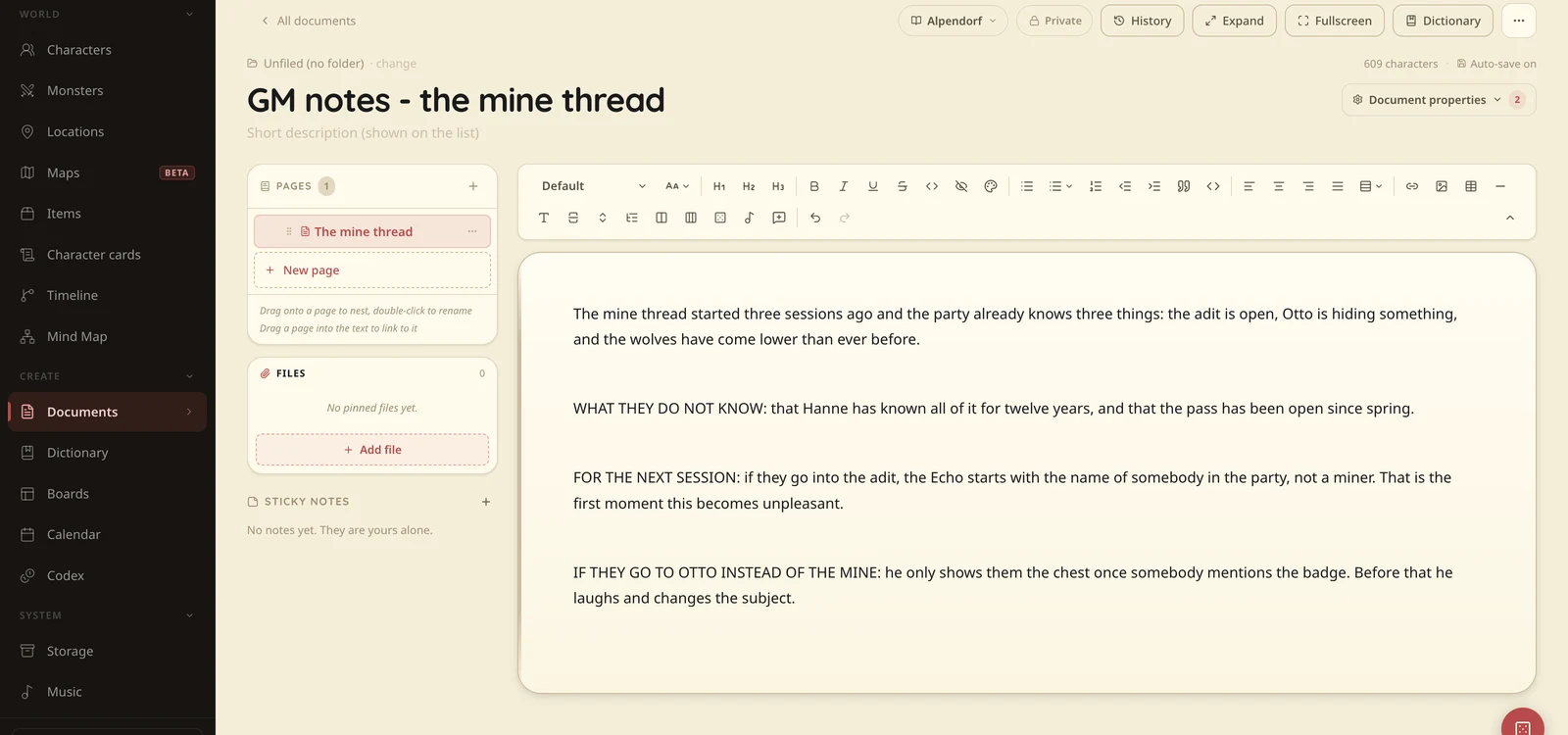
If you know what is happening, why it is happening and what happens if the players do nothing, you already have most of the session.
Start with one sentence
Before writing NPCs, maps and encounters, answer:
What should the players know or feel by the end of this session?
Not what they must do.
That difference matters.
"Players must find the entrance to the mine" closes possibilities.
"Players should discover that the source of the problem is beneath the village" leaves many paths open.
That sentence becomes your compass.
When you start writing the childhood history of the sawmill owner, look at it again.
Does this help the session do what it needs to do?
If not, stop.
Prepare a few scenes, not an order
You can still prepare scenes.
Just do not chain them together so tightly that one missed clue destroys the evening.
For Alpendorf, you might have:
Arrival in the village
Everyone knows something is wrong. Dogs refuse to cross one street. The innkeeper wants outsiders to leave quickly.
Another disappearance
Someone vanishes while the party is in town. Now there is pressure, fresh evidence and a witness who knows more than they want to say.
Singing under the stone
At night, the characters finally hear it themselves.
A voice, very far below.
You do not need to know the exact order.
The players will create that for you.
NPCs need character, not biographies
One of the easiest ways to overprepare is to create excellent material that never becomes usable during play.
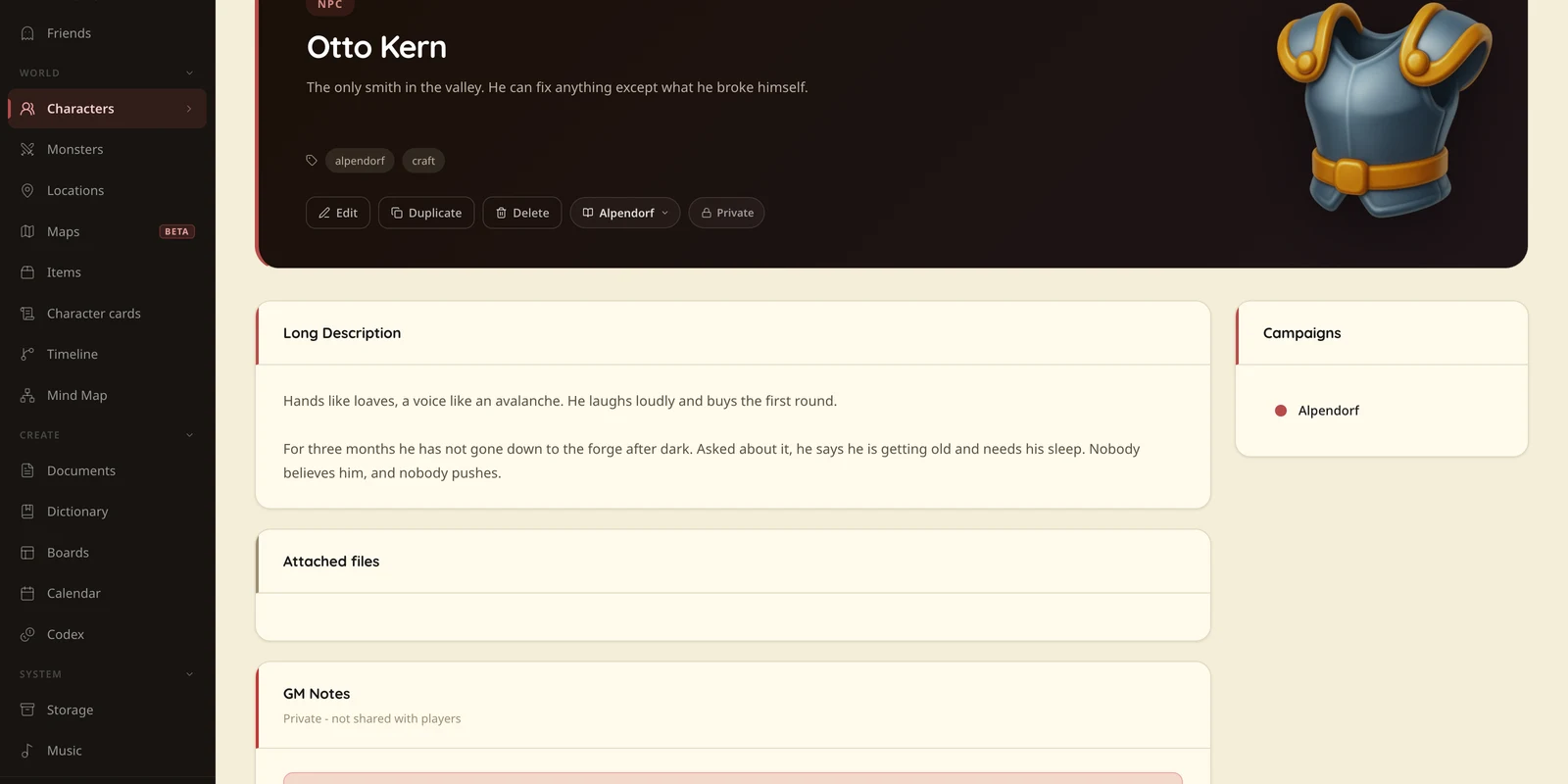
NPCs are a common example.
If somebody appears for ten minutes, you do not need two pages of their life.
You need enough to perform them.
Marta, the innkeeper:
**First impression:** Polite, but clearly wants the strangers to solve their business and leave.
**Wants:** Peace.
**Fears:** Someone will ask about her brother.
**Hides:** Her brother disappeared near the old mine several weeks ago. She never reported it.
**Knows:** Dogs start howling shortly before the underground singing begins.
Five lines.
You already know how Marta talks, how she reacts to questions and what information she can move into the story.
If the players love her, expand her later.
If they leave after five minutes, you did not waste an hour on her childhood.
Prepare clues, but do not lock them to one place
The players need to discover that someone has recently returned to the mine.
You prepared a perfect scene where the old blacksmith saw a lantern on the hillside.
Problem:
The party never visits the blacksmith.
If information is important, do not imprison it inside one conversation.
Write the information itself:
Someone is visiting the mine at night with a lamp.
Then let the world deliver it.
The blacksmith can mention it.
A child watching goats can mention it.
The party can find fresh candle wax on the path.
A lamp can be left outside the inn.
They can see the light themselves.
Prepare information, not the one correct method of discovering it.
Make a list of things they can learn
A few are enough.
For example:
- the strange events began three weeks ago,
- every animal reacts to the north side of the village,
- the old mine was closed years ago,
- someone recently cut the chain across its entrance,
- Marta lost her brother there,
- something below the mine is older than the village.
Not all of these need to appear.
They do not need to arrive in the same order.
The players may never discover some of them.
That is fine.
A session is not a presentation where you must reach the last slide.
Prepare places to play in, not descriptions to read
It is easy to write:
The Broken Horn Inn is a two-storey structure built approximately one hundred and twenty years ago from local timber...
You probably will not read that during the game.
More useful:
- smells of wet wood and smoke,
- a huge antler hangs above the fire, broken on one side,
- the innkeeper stops talking whenever somebody mentions the mine,
- the same old man sits at one table every evening,
- quiet knocking can be heard from the cellar at night.
These are things players can interact with.
They can ask about the antler.
Talk to the old man.
Notice the innkeeper's reaction.
Go into the cellar.
A good location description does not only tell you how a place looks.
It gives the players handles.
Put session material where you can reach it
Before the game, everything seems organised.
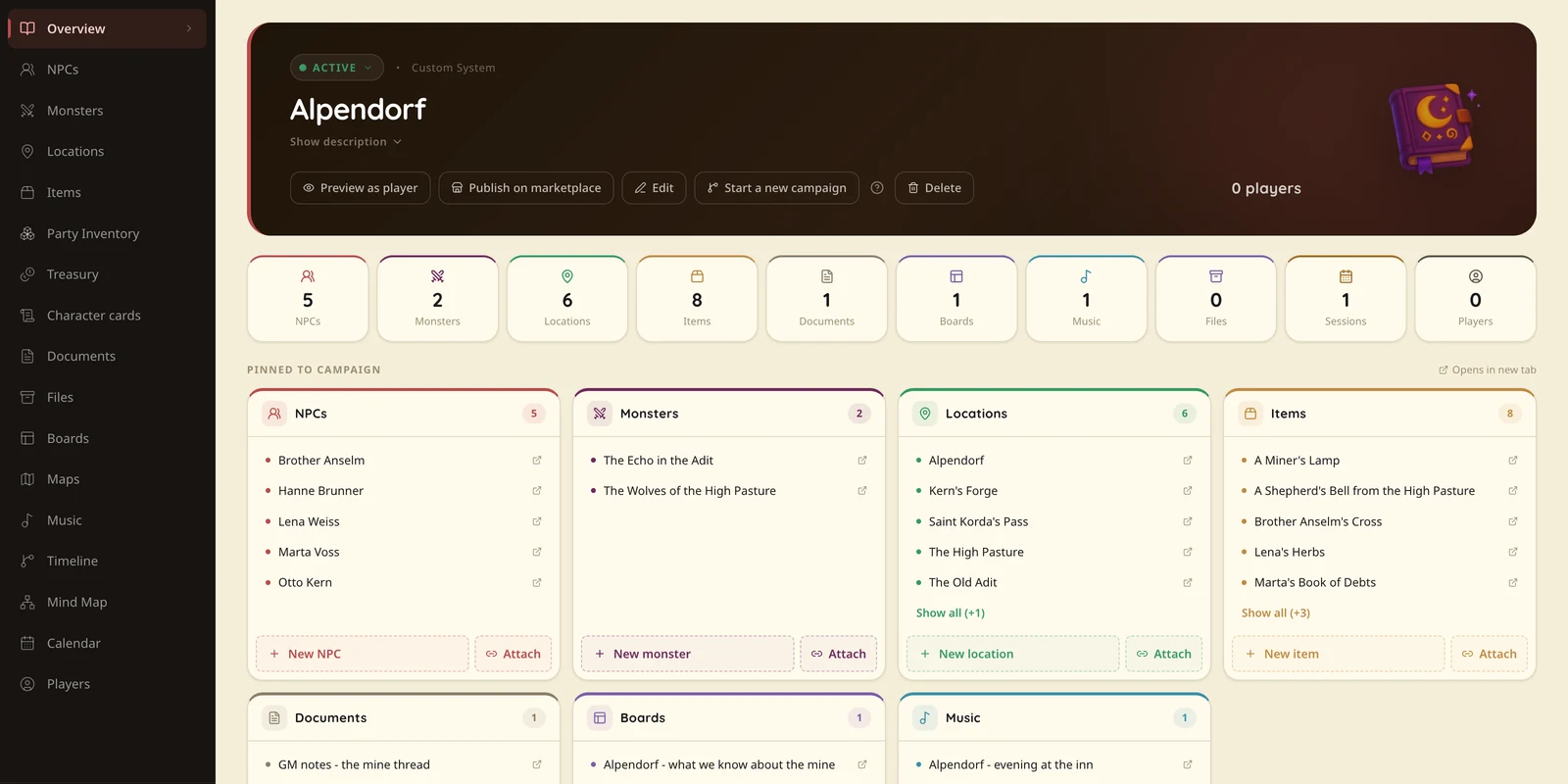
During the game, you have about five seconds before everyone starts looking at you.
Map.
NPC.
Previous session notes.
Item description.
Music.
A letter found on a body.
If every piece lives somewhere else, running the game turns into channel surfing.
There is no one correct organisation system.
Paper binders work.
Notion works.
OneNote works.
Five Google Docs can work if you genuinely know which one contains the cultist list.
My preference is simple:
Things I may need in the same scene should be close to each other.
That is how I use Talehaven. Campaign documents, locations, NPCs, maps and other elements sit in the same campaign instead of becoming an expedition across folders every Saturday.
The useful part is not having more features.
It is having one fewer thing to think about while a player is trying to convince a guard that a dead horse is their legal representative.
Do not prepare an answer to every possibility
New GMs often worry about this.
What if they go there?
What if they kill this NPC?
What if they refuse the job?
You can spend five hours answering questions the players never ask.
Instead of preparing branches, prepare motivations.
What does the antagonist want?
What is the village afraid of?
What will Marta do?
What is the guard protecting?
Why did somebody reopen the mine?
When the players do something strange, stop asking:
Did I prepare this option?
Ask:
How would this person react?
Then keep playing.
Keep one emergency tool
Every GM knows the moment when the party finishes the prepared material much earlier than expected.
Or ignores the main clue.
Or the session simply needs a new pulse.
Have one thing ready that is not attached to a specific part of the plot.
A wounded traveller coming from the forest.
An abandoned wagon.
A letter containing one character's name.
Someone running away from something still unseen.
A dead animal with unfamiliar marks.
An NPC with a small problem.
You may never use it.
But if the session needs it, you have something ready.
Everybody will assume you planned it from the beginning.
There is no reason to correct them.
What about maps, music and handouts?
They are great.
A good map can explain space instantly.
One carefully chosen track can create more atmosphere than three minutes of describing rain.
A physical letter placed on the table can turn ordinary information into an event.
But these are additions to the session, not the session itself.
Prepare the situation, people, places, information and consequences first.
Decorate afterwards.
If you have only thirty minutes
Do this:
**5 minutes:** Write one sentence explaining what is happening and why the characters should care.
**5 minutes:** Create three people. One wants to help. One causes trouble. One knows more than they say.
**5 minutes:** Create three places. One sentence of atmosphere and two interactive details each.
**5 minutes:** Write five pieces of information the party might discover.
**5 minutes:** Decide what happens if the characters do nothing.
**5 minutes:** Open the maps, notes, NPC cards, music and rules you may need.
Then stop preparing.
Seriously.
The best part will probably happen between your notes
You are not preparing a session so the players can perform the story you already wrote.
You are preparing fuel.
People with problems.
Places hiding interesting things.
Secrets.
Conflicts.
Consequences.
Then you sit down and see what the party does with them.
Sometimes they skip your best location.
Sometimes a random guard receives a name, a family and an entire subplot.
Sometimes something invented in five seconds becomes more important than the thing you spent an hour creating.
That is why this works.
You do not need everything prepared.
You need enough prepared that you feel comfortable inventing the rest.
And then you watch them go left.
If what we are building is useful to you, you can buy us a coffee.
Support on Ko-fiKeep one campaign in one place
Documents, NPCs, locations, maps and music next to each other - so the session does not start with a search.
Try Talehaven