
Railroad or Sandbox? The Problem Isn't the Rails. It's Fake Choices
The Talehaven team13 min read
The Game Master has prepared a campaign.
There is a murder, several suspects, a trail leading to an old monastery and a finale that has been looking very good in their head for the last week.
The party finds the first clue. They talk to the innkeeper. They read a letter.
Then they decide:
We're not going to the monastery. Let's check the harbour.
The GM looks at the notes.
The monastery has a map, NPCs, a prepared encounter and even a soundtrack.
The harbour has the names of two ships and a dockworker invented three minutes ago.
This is where the real test begins.
Do you let them go to the harbour even if half of your preparation becomes useless? Do you give them another good reason to reconsider the monastery? Or does the person they were supposed to meet at the monastery somehow turn up at the harbour by complete coincidence?
That last option is tempting.
It is also where the rails often begin.
A linear campaign is not the same thing as railroading
These two ideas get mixed together far too often.
A linear campaign can have a clear direction. The characters receive a job, pursue an enemy, travel to a city, then to a fortress and eventually reach a finale the GM roughly anticipated.
There is nothing inherently wrong with that.
If everybody agreed to play a campaign about hunting a necromancer, it would be strange to demand that the GM instantly turn it into a bakery management game because the party decides three sessions in that bread looks more interesting.
The problem begins when the players make a decision and the world replies:
It doesn't matter. The same thing happens anyway.
In a linear story, the players may know roughly where the campaign is heading, but they still decide how they get there, who they trust, what they sacrifice and what they change along the way.
In a railroad, those decisions look real but have no meaningful effect.
A simple example
The murderer escaped to Nuln. The GM has prepared the next part of the story there.
That can still be a linear plot.
The party finds evidence pointing towards Nuln and decides to follow. Maybe they hesitate, so the GM introduces new consequences, another witness or someone important who also leaves for the city.
The world moves and the main plot remains visible.
Now imagine the party says:
We are not going to Nuln. We are heading to Middenheim.
Ten minutes later, the murderer has apparently also gone to Middenheim.
The location changed. The prepared scene did not.
The players could have said Nuln, Middenheim or Kislev. The story was waiting for them in the next room anyway.
That is the problem.
Players do not need infinite freedom
The opposite extreme is not automatically better.
You can prepare a huge map, six cities, twelve factions, political conflicts, rumours, trade routes and complete freedom.
Then the players sit down.
What do you do?
Four people look at each other.
Well... what can we do?
Complete freedom does not always create agency. Sometimes it creates a lack of direction.
Players often want to know that something worth their attention is happening. They want a hook, a problem, someone asking for help, a threat or a piece of information that starts the story.
They do not need fifty identical doors.
They need to know that the door they choose leads somewhere because they chose it.
Railroading often begins during preparation
The issue does not always come from a desire to control the players.
Sometimes it comes from the amount of work you did.
If you spent three hours preparing a detailed monastery map, its inhabitants, a puzzle, a crypt encounter, enemies and a final conversation with the abbot, it is difficult to watch the party casually say:
We are skipping the monastery.
The GM does not only hear "we chose another route."
They also hear "three hours of preparation just disappeared."
One of the best ways to avoid railroading is therefore not simply to become better at improvisation. It is to prepare in a way that hurts less when players change direction.
Prepare pieces, not a roller coaster
Consider this structure:
The party talks to the innkeeper.
The innkeeper tells them about the mill.
At the mill they find a letter.
The letter leads to the mine.
In the mine they meet smugglers.
One smuggler reveals the leader's location.
If the party does not trust the innkeeper, half the document starts wobbling.
Now prepare the same adventure differently.
- The innkeeper knows the miller leaves at night.
- There are signs of smuggling in the mill.
- One of the transported objects came from the mine.
- The smugglers use an underground route.
- Their leader is hiding something much bigger than smuggling.
It is still the same story.
But instead of six steps, you have people, places, information and conflicts.
The players can start at the mill. They can follow a smuggler. They can find the object somewhere else. They can completely ignore the innkeeper.
The story survives because it was never tied to one path.
This is why separating campaign elements helps
A campaign document is useful for the overall idea, session notes and the things you want in front of you.
But an NPC can still be an NPC. The mill can be a location. The letter or medallion can be an item. The mine can exist on the map. The relationship between the innkeeper and the smugglers can exist independently from the order of scenes.
That is one reason we built Talehaven around separate campaign elements rather than one enormous document.
Preparation becomes a box of pieces instead of a model glued permanently to the base.
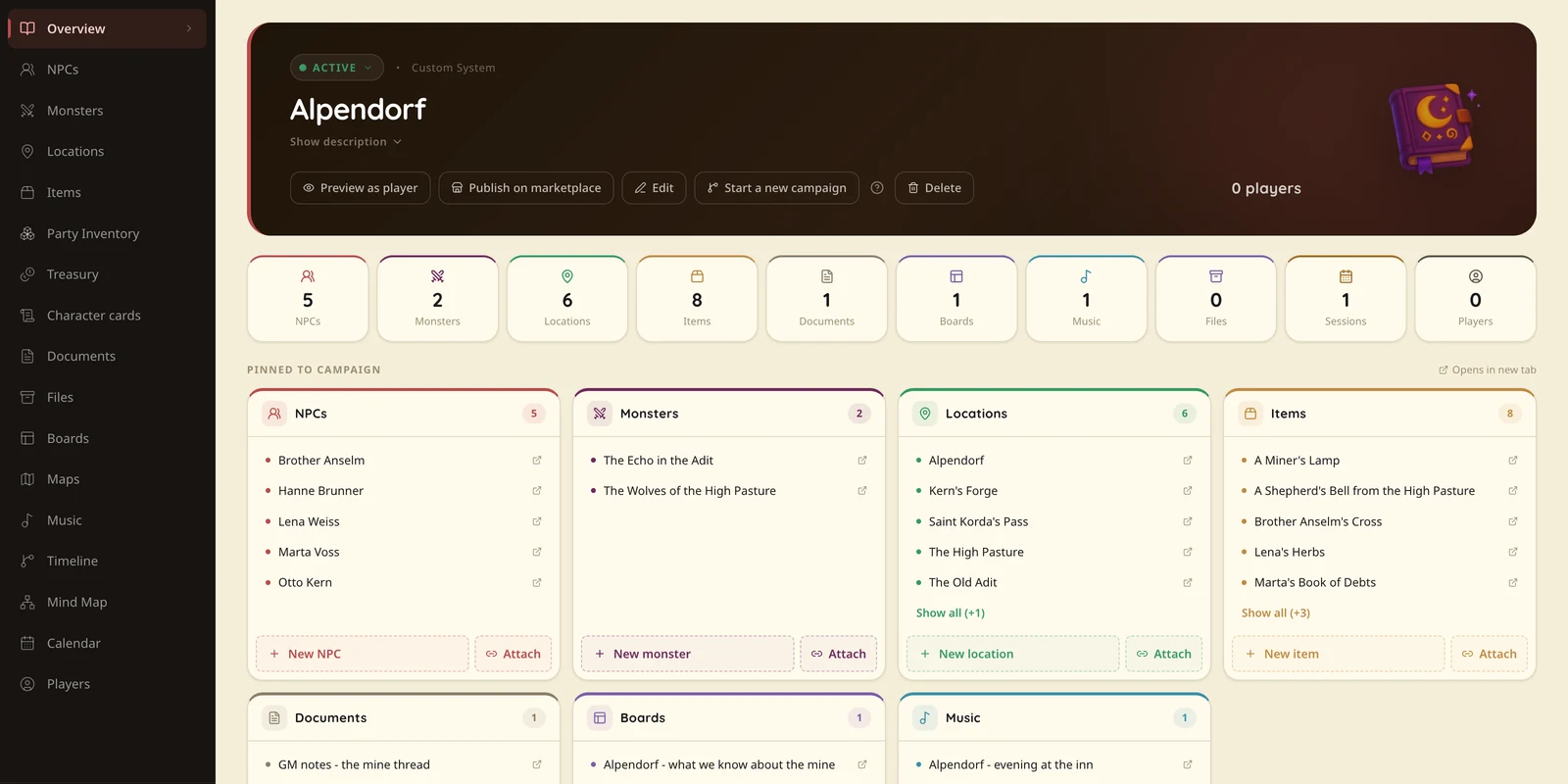
If the players do not visit the mill today, the mill still exists. If they never meet the innkeeper, his information still exists in the world. If they skip the map you prepared, you can use it later.
Or not at all.
"But I still need to get them into the story"
Of course.
The GM does not need to sit silently until the party accidentally discovers the plot.
Show consequences. Introduce witnesses. Let the antagonist act. Remind the players that the problem still exists.
If the party ignores bandits attacking the road, the bandits should not freeze in time while the characters go monster hunting.
A week later, the road may be closed. A month later, merchants may avoid the region. Someone important starts losing money.
Eventually the problem may come looking for the characters.
That is not railroading.
That is a world that continues while the players are looking somewhere else.
Consequences are better than invisible walls
The worst way to stop players is often the most obvious.
You cannot go there.
Why?
The road is closed.
Then we go through the forest.
There is an avalanche.
In the forest?
A very unusual avalanche.
Players can feel when reality suddenly bends to keep them on the prepared route.
A better version is:
You can go there. But if you abandon the chase now, the person you are hunting gains three days.
The decision is still theirs.
It simply has a price.
Agency is not the absence of consequences. Consequences are often what make a choice feel real.
A good antagonist makes everything easier
When the players do something unexpected, ask:
What does the opposition do now?
The characters miss a meeting. The antagonist meets someone else.
They refuse to defend a village. The attack succeeds.
They ignore a witness. The witness may be silenced.
Instead of thinking "how do I put them back on the path?", you start thinking "how does the world respond?"
The story moves again without teleporting the monastery underneath the party.
Sometimes a board works better than a scene list
For a more complicated campaign, try mapping people, places, factions, objects and information, then connect the relationships between them.
The innkeeper knows the smuggler. The smuggler uses the mill. The miller owes a local noble. The noble finances an expedition to the mine. Something was found under the mine that should have stayed buried.
Players can enter this network from several directions.
You still know what matters. You still prepared a story. You simply did not decide which thread they must pull first.
Not every decision needs to change the world
Agency does not mean every choice creates a completely new timeline.
Sometimes a decision changes the method used to solve a problem.
Sometimes it changes a relationship.
Sometimes the cost of victory.
Sometimes who survives.
Sometimes only how the party feels about what happened.
The important thing is not that every decision is enormous.
The important thing is that at least some of them are real.
The illusion of choice can work, but use it carefully
Every GM has reused an encounter.
You prepared bandits on the hill road. The party goes through the forest instead. The bandits are now in the forest.
Is that railroading?
The more useful question is whether the route was supposed to matter.
If both roads were simply flavour before the next scene, probably nothing terrible happened.
But if you said:
The forest is shorter but dangerous. The hill road takes an extra day but is safer.
and the players deliberately choose the safer route, lose the extra day and get exactly the same ambush anyway, the world has just told them their choice was meaningless.
That matters much more than reusing a prepared encounter.
Tell players what kind of campaign they are joining
A lot of conflict around railroading can be prevented before session one.
If you prepared a campaign about an expedition through the Grey Mountains, say so.
If you want an open sandbox, say so.
If the scenario has a strong central plot and the characters should have a reason to care about it, say that too.
Players can willingly accept boundaries.
"We are playing the crew of a ship searching for a missing expedition" is a limitation, but it still leaves a huge amount of space for decisions.
The problem is not that boundaries exist.
The problem is when players discover them only after running face-first into them.
And if they really go somewhere completely different?
Sometimes they will.
You prepared half the campaign in the north and the party decides to go south.
You are allowed to say:
Okay, I did not prepare that at all.
Improvisation is a tool, not a contractual obligation to procedurally generate an entire world in real time.
You can also ask players to tell you before a session if they intend to leave the prepared region.
That is not railroading.
It is respect for the time of the person preparing the game.
Direction is good. Fake choices are not
I like knowing roughly where a campaign is going.
I like having an antagonist, several important places and events that may happen if nobody interferes.
What I do not want to know is exactly how the party gets there.
Because if I already know everything before the session, the players become slightly less necessary.
Prepare people. Places. Conflicts. Secrets. Things that will happen if nobody stops them.
Then put the players in the middle and see what they do.
Sometimes they will follow the road you expected.
Sometimes they will wreck half the plan in fifteen minutes.
A good campaign does not answer that with "you cannot."
It answers:
All right. Let's see what happens.
If what we are building is useful to you, you can buy us a coffee.
Support on Ko-fiKeep one campaign in one place
Documents, NPCs, locations, maps and music next to each other - so the session does not start with a search.
Try Talehaven