
How to Create an RPG Character You Will Actually Want to Play
The Talehaven team14 min read
You can create a character with three pages of history, fully described parents, a date of birth and an exact explanation of why they stopped talking to their uncle at the age of nine.
Then you can start the first session and realise you have no idea how to actually play them.
Or you can arrive with something much smaller:
A former city guard who believes everyone deserves a second chance. The problem is that he once gave one to somebody who absolutely did not deserve it.
That one sentence does not tell us where he was born or what colour his eyes are.
It does give us questions.
What happens when an enemy surrenders? How does he treat a thief? Does he still believe in his rule after what happened? Who was the person he trusted?
A good character does not begin when we know everything about them.
It begins when we know enough to want to discover more.
A character sheet is not yet a character
A character sheet answers useful questions.
How well do you fight?
Can you pick a lock?
How much can you carry?
How likely are you to convince the guard to open the gate?
It does not explain why you want the gate opened.
It also cannot tell us whether you let the same guard leave when he surrenders five minutes later.
Numbers describe what a character can do.
Character begins with decisions.
Before writing a complete biography, find a few things you can actually play at the table.
Describe the character in one sentence
This is harder than it sounds.
This is data:
Felix, human, 32, former soldier from the northern Empire.
This is a character:
Felix survived the war because of people he once considered cowards, and he is no longer sure whether he believes everything the army taught him.
Or:
Greta became a priest because she genuinely believes in her god, but every session she trusts the people claiming to speak for that god a little less.
Both sentences contain movement.
Something can change.
The character has a starting point but not a finished ending.
That is a very good place to begin a campaign.
Start with the person, then write the history
Character creation often falls into chronology.
Born here. Father did this. Mother was that. At twelve, an important event happened.
Half an hour later you have a biography.
You may still not have a playable character.
Try starting with the present.
Who are you now?
What do you want now?
What is your problem today?
Then write the past only where it helps explain those answers.
If your character is terrified of enclosed spaces, the reason may matter.
If they have a perfectly good relationship with parents who will never appear in the campaign, you probably do not need their ages and professions.
Backstory should work for the character, not the other way around.
Give them something they want
"I want to save the world" is weak if the world is not in danger yet.
Personal goals often work better.
Recover the family home.
Prove to your father that your life was not wasted.
Never depend on anyone again.
Find the person who disappeared years ago.
A good goal does not need to be grand.
It needs to matter to this person.
It also gives the GM material.
Imagine that after twelve sessions, someone offers to return the family estate.
They do not want gold.
They want one favour.
The question is no longer "do we accept the quest?"
It becomes "how much is the thing I have wanted since session one really worth to me?"
Give the character a concept and a problem
A useful shortcut is to think in two parts.
The concept tells us roughly who the character is.
The problem tells us why being that person is difficult.
A young doctor who will do anything to save a patient.
Problem: he cannot accept that sometimes people cannot be saved.
An excellent swordsman from an aristocratic family.
Problem: he has spent his whole life being told his family name is enough to make him important, and some part of him still believes it.
A problem does not need to mean trauma, murdered parents and three diagnoses.
It can be a flaw, contradiction, belief or habit that creates difficult decisions.
Ideally, it is something we can actually see during play.
"Stubborn" is not enough
"Brave, loyal, suspicious and stubborn" tells us very little.
What does a suspicious person actually do?
Replace labels with behaviour.
Greedy becomes:
They remember every coin anybody owes them, even if the other person forgot years ago.
Brave becomes:
When things become dangerous, they always try to stand in front.
Loyal becomes:
They can insult their friends all evening, but the second a stranger does it, the conversation changes.
Now we can play it.
For every personality trait, ask:
How would another character notice this about me?
If you cannot answer, you probably still have a label rather than behaviour.
Family matters when it is a relationship, not a completed field
Father: blacksmith.
Mother: herbalist.
Brother: Johann.
Technically finished.
But what does any of it mean?
Try questions like:
- Which family member do you no longer speak to, and why?
- Who are you still trying to impress?
- Who would you return home for immediately?
- Who knows you much better than you would like?
Now:
I have an older sister.
can become:
I have an older sister. We have not spoken for four years because I took the money meant for our father's treatment and fled the city.
The GM did not just receive an NPC called Anna.
They received a relationship.
We still do not need to know where Anna lives.
Good backstory leaves doors open
Closed backstory:
My brother was kidnapped by the Cult of the Red Moon. They are holding him in a temple in the north under a priest called Erhardt, who used to be my father's friend.
Open backstory:
My brother disappeared three years ago. His last letter came from a city in the north. I have found no trace of him since.
The second version says less but creates more possibilities.
Maybe he was kidnapped.
Maybe he ran away deliberately.
Maybe he does not want to be found.
Maybe the party is sitting in an inn hundreds of miles away when somebody at the next table uses an expression the character learned from their brother.
Leave space for the campaign to answer questions with you.
Connect the characters before connecting them to the plot
We all know the classic opening.
Five strangers sit in a tavern.
Every one of them is armed.
Every one of them happens to be looking for work.
You can do better with one relationship between characters before the first session.
They do not need to be friends.
One once saved the other's life. What happened?
Both know the same person but have completely different opinions about them. Who is it?
One knows something about the other that the rest of the party does not.
They once worked together. Why did they stop?
A few answers can make the party feel like a group before the opening quest begins.
One object can say more than half a page of backstory
Do not ask for the character's most expensive possession.
Ask:
What would you never sell?
An old medallion.
A key to a house that no longer exists.
A letter read so many times it is falling apart.
A bottle of wine you were supposed to open with someone who never returned from the war.
Then ask why you still carry it.
Sometimes that answer creates more character than the entire "history" field.
It also puts something tangible into the campaign. The object can be recognised, stolen, lost or returned.
A secret is useful only if it can stop being secret
If a secret is known only to the player and can never affect events, it is trivia.
A useful secret changes how the character behaves around others.
They are not who they claim to be.
They once worked for the person the party is hunting.
They cannot read and have successfully hidden it for months.
They know something about another party member that person does not know yet.
You do not need a dramatic traitor reveal.
Sometimes the best moment is an ordinary conversation where somebody asks one question too many and the player has to decide whether to keep lying.
Most NPCs need much less
Nearly everything above also works for NPCs, but usually in a smaller dose.
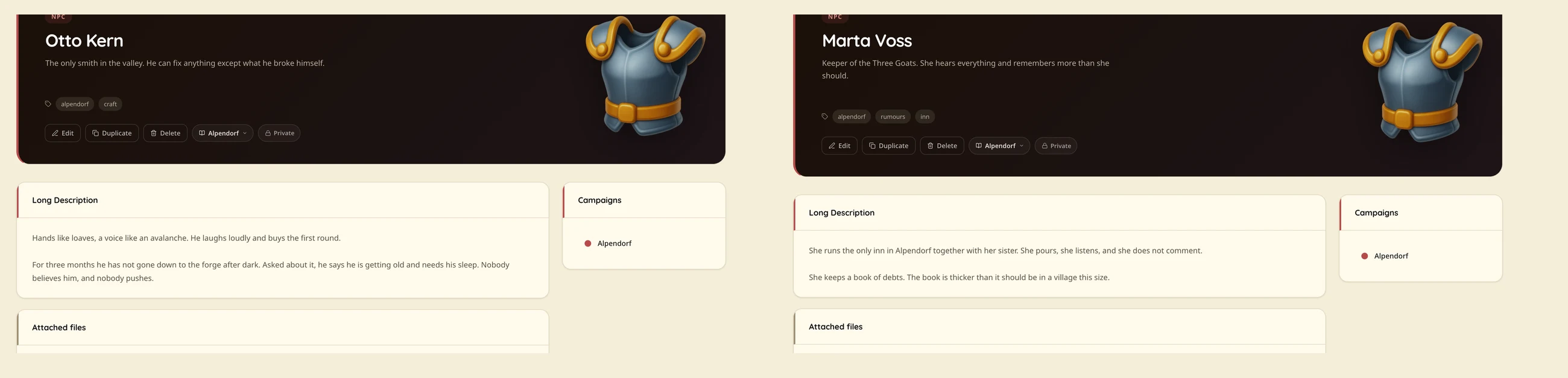
If an innkeeper appears for ten minutes, they do not need a life story.
Four things are enough.
Who are they?
A former soldier running an inn.
What do they want?
For their daughter never to see a war.
What is their problem?
They still react to conflict as if they were on the front line.
What are they hiding?
They keep the weapon of a man they were ordered to kill during the war.
You can play that NPC immediately.
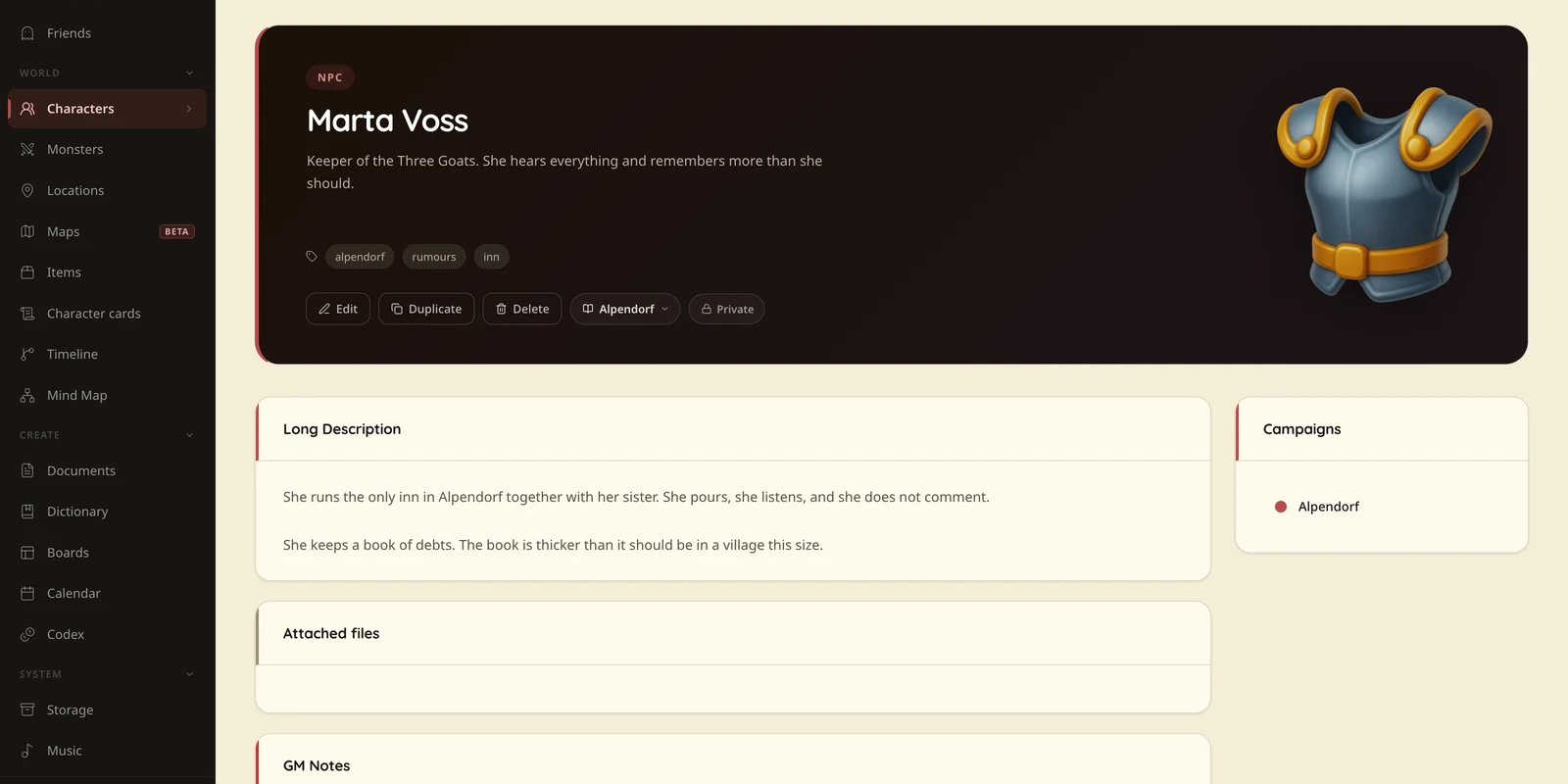
If the party drinks a beer and leaves, you did not waste time.
If eight sessions later they decide this is their favourite person in the city, expand the character then.
Give the GM a few handles
A character does not need a finished storyline.
They need things the campaign can grab.
Someone they owe a favour.
A place they are afraid to return to.
A person they are still searching for.
A promise they broke.
An object whose origin they do not know.
Someone who sees them very differently from how they see themselves.
The GM may use one of these after two sessions or twenty.
That is when an ordinary encounter becomes personal.
Contradictions make people interesting
People are rarely consistent.
A knight can believe in honour and still be terrified of dying.
A priest can believe completely in a god and distrust the church.
A thief can rob rich people without hesitation and still send half the money home to his mother.
Give your character two things that do not fit together perfectly.
That friction creates decisions.
And decisions are what you will actually be playing.
You do not have to start with a blank page
If you want to build a character now and the empty sheet is still winning, we prepared three short documents. Print them, or keep them open next to the character sheet.
If what we are building is useful to you, you can buy us a coffee.
Support on Ko-fiKeep one campaign in one place
Documents, NPCs, locations, maps and music next to each other - so the session does not start with a search.
Try Talehaven