
How to Start Playing Tabletop RPGs
The Talehaven team13 min read
And how not to turn it into a three-month project.
You want to try tabletop RPGs.
You watch a few videos, open a forum, ask some friends and an hour later discover hundreds of systems, several kinds of dice, core books, supplements, GM screens, maps, miniatures, online platforms and people who have spent twenty years arguing about initiative.
At that point, deciding to play a board game instead starts to sound reasonable.
Tabletop RPGs are much simpler than they can look from the outside.
For your first session, you mainly need a few people, rules you understand well enough to use and somebody willing to say:
It's raining. It is late. You are standing in front of a locked city gate, and the guard says nobody gets in tonight. What do you do?
The rest can come later.
So what is a tabletop RPG?
At its simplest, it is a group creating a story by making decisions instead of deciding the whole story in advance.
One person runs the world. We usually call them the Game Master, GM, Dungeon Master or another title depending on the game. Everybody else plays a character.
The GM describes the situation.
The innkeeper says he has not seen the missing merchant for three days.
A player decides what their character does.
I don't believe him. I want to see whether he is hiding something.
If the result is uncertain, the rules step in. Maybe you roll dice, compare a skill, draw a card or spend a resource.
Then the situation changes.
There is no final square on a board you must reach. There is rarely one correct solution. Very often, the GM does not even have a prepared answer for the thing the players just attempted.
That is the point.
Do not start by searching for the perfect system
This is one of the first traps.
You ask:
What is the best RPG for beginners?
and receive seventeen different answers.
D&D. Warhammer. Dragonbane. Call of Cthulhu. Savage Worlds. Fate. Something extremely light. Something old-school. Something published three weeks ago.
Everybody has reasons.
For your first game, finding a system you actually want to play is more important than finding the theoretically perfect beginner system.
If you want dungeons, swords and magic, play fantasy.
If you want investigations and things humanity was better off not discovering, try horror.
If everybody loves cyberpunk, do not force yourselves into traditional fantasy because someone online said it is easier.
The rules should help you play the kind of story you are excited about.
You are not taking an exam.
You do not need to know every rule
You will forget something.
The players will too.
Someone will calculate a modifier incorrectly. An hour later, you will discover you handled a combat rule wrong for the entire fight.
Nothing terrible happens.
If every uncertainty turns into fifteen minutes of searching the rulebook, you will stop playing and start reviewing documentation.
For the first session, it is usually enough to understand:
- the basic resolution mechanic,
- how conflict or combat roughly works,
- how to read a character sheet,
- what the characters can generally attempt.
Look up the rest when it becomes relevant.
If nobody knows how to resolve something, the GM can make a temporary ruling and check the official rule after the session.
That is normal.
Who is supposed to run the game?
Someone has to try first.
It does not need to be the person who has read the rulebook three times and can quote falling damage tables from memory.
Most first-time GMs become GMs because they said:
I can give it a go.
That is enough.
Running your first game is not about producing a masterpiece. Your main job is to put a situation in front of the players and respond to their decisions.
If the characters reach a village where people are disappearing, you do not need twenty possible paths.
You need to know:
- who is disappearing,
- why,
- who knows something,
- where the evidence points,
- what happens if the players do nothing.
The rest can happen at the table.
Your first adventure should be smaller than you think
Your first scenario does not need to decide the fate of a continent.
A simple problem works better.
Someone has disappeared.
An important object was stolen.
A caravan never arrived.
Something strange is happening in the nearby forest.
A body was found at an inn and nobody saw the killer.
A small story gives everyone space to learn the game without memorising eleven kingdoms, five knightly orders and a war from four hundred years ago.
If you still want a larger world after three sessions, build it then.
RPGs are very good at growing as you play.
What about characters?
Premade characters are a perfectly good idea for a first game.
Making your own character is great, but if nobody understands the system yet, spending two hours choosing abilities before the first roll can drain the excitement quickly.
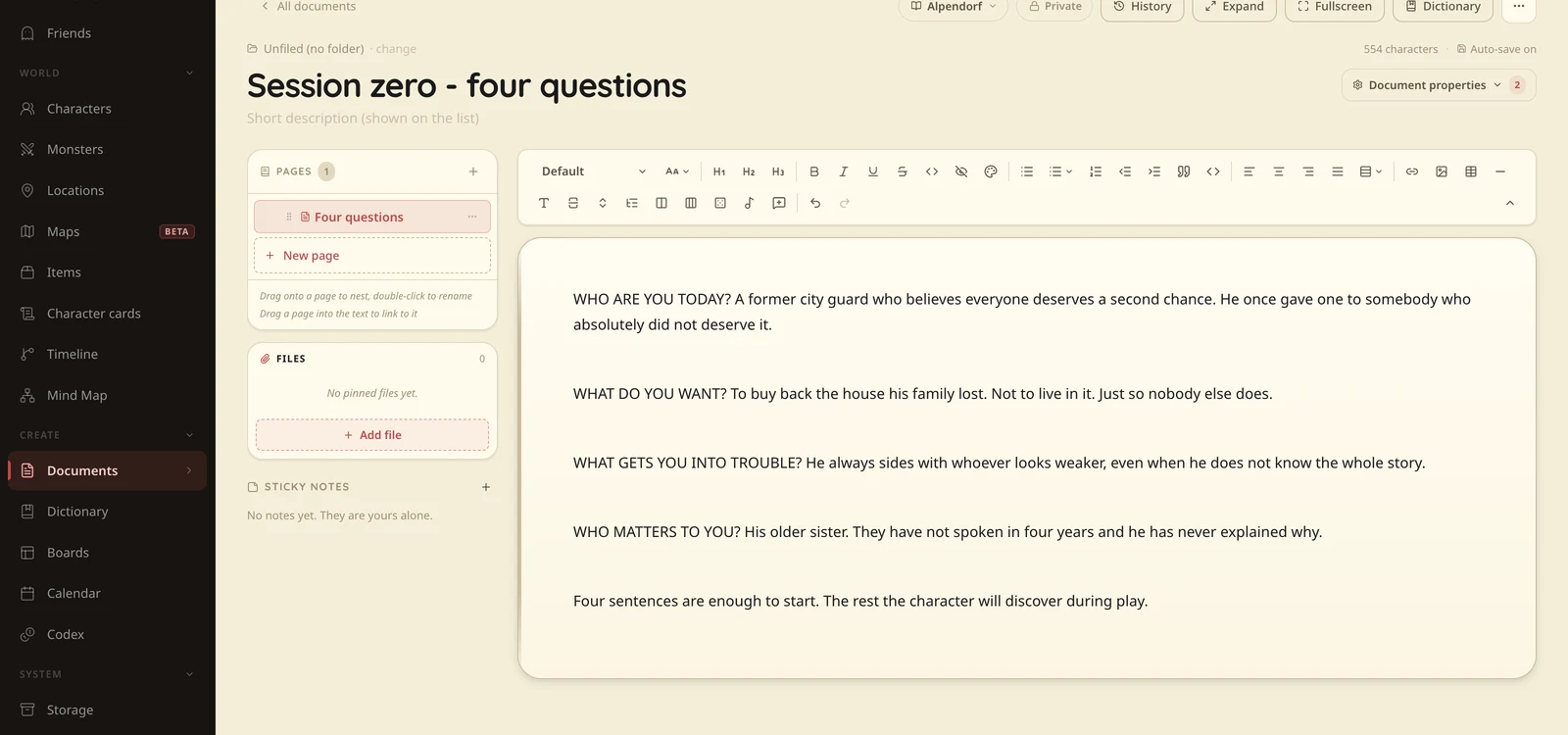
You can start with ready-made characters, play a short adventure and create your own heroes later.
If you do want to make characters immediately, skip the five-page biography.
Answer a few questions:
- Who am I?
- What do I want?
- What regularly gets me into trouble?
- Who matters to me?
- Why am I here right now?
That is enough to begin making decisions as somebody other than yourself.
Do you need dice?
Probably.
But not necessarily the expensive gemstone set you saw in a beautiful photo.
Different systems use different dice. Many use some combination of d4, d6, d8, d10, d12 and d20. Some use only ordinary six-sided dice. Digital rollers work too.
If you enjoy the game, you can buy your own set later.
Then another.
Then another.
Nobody really knows why RPG players eventually own enough dice to supply a small casino.
You do not need miniatures, terrain or an expensive gaming table
RPGs look impressive in photographs.
Large maps. Miniatures. Candles. Wooden GM screens. Metal coins. Mugs. Music. Lighting.
All of it can be great.
None of it is required.
You can play at a kitchen table with paper and pencils. If you need a map, draw rectangles. If you need a miniature, use a coin. If you do not have atmospheric music, play without music.
Do not delay the first game because it does not look like a YouTube production.
First find out whether you enjoy playing.
Have a session zero, even a short one
"Session zero" sounds more formal than it needs to be.
It is simply a conversation before the campaign starts.
What are we playing?
What tone do we want?
Do we want more combat, conversation, exploration or investigation?
Are there topics anybody wants kept out of the game?
How often do we want to play?
Do the characters already know each other?
What do we expect from this campaign?
One person may expect heroic fantasy. Another political intrigue. A third has created a character whose entire personality is murdering everything that moves.
Better to discover that before the opening scene.
The biggest beginner problem is waiting for the perfect moment
We will start after we finish the book.
I still need a map.
Everyone needs to finish their characters.
I need to watch another combat tutorial.
We still need dice.
We have to find the perfect date.
Two months pass.
You still have not played.
Your first session probably will not be perfect. The GM will hesitate. Players will ask rules questions. Somebody will forget how an ability works. Someone will say something ridiculous and the whole table will lose five minutes laughing.
That is not the session going wrong.
That is a session.
You do not prepare until you are finally good enough to begin.
You begin so you can learn how to play.
Do beginners need Talehaven?
No.
You do not need Talehaven to play your first session, just like you do not need a special table, thirty miniatures or a six-hour soundtrack.
Paper, pencils and the rules are enough.
A campaign tool becomes useful a little later.
During session two. Then session three.
The players meet an innkeeper you invented on the spot. Someone finds a strange medallion. You name a village everybody likes. One character mentions a sister during session zero. A mine appears on the map.
Suddenly those things are worth remembering.
Not because you are running an epic campaign.
Because three weeks later a player will say:
We go back to the guy who gave us the horses.
And you remember the horses.
You remember the guy.
Almost.
Start small in Talehaven too
A campaign app can create another temptation: preparing everything.
Do not.
On day one, you do not need twenty NPCs, a world map and the complete history of every town.
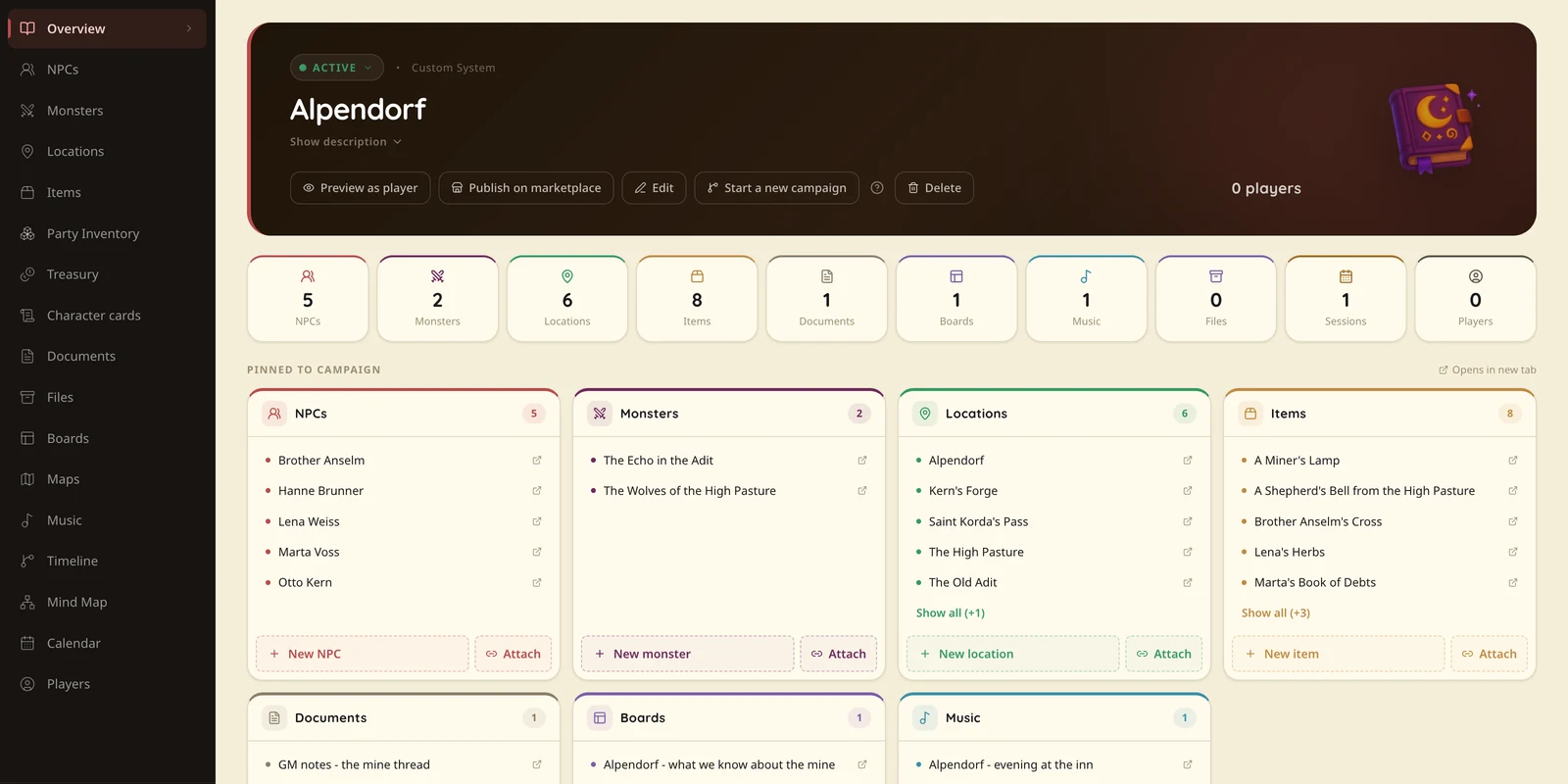
Create the campaign.
Add the place where the first scene happens.
Add two or three people the characters may actually meet.
Write one short scenario document with the problem, clues and consequences.
Add an item when it appears in play.
Not before.
The campaign should grow with the game instead of becoming another form you need to complete before you are allowed to start.
What does a good first session look like?
It does not need a huge finale.
It does not need to last six hours.
It does not need three fights, a puzzle and a dramatic twist.
If the session ends and somebody asks:
So when are we playing again?
it worked.
Maybe the players missed half your clues. Maybe they skipped your best scene. Maybe the NPC you considered irrelevant became their favourite character.
Welcome to tabletop RPGs.
This will happen regularly.
The really short checklist
Before your first session:
Pick a game you genuinely want to try.
Find a few people who want to play.
Choose a date and stop waiting for the perfect one.
Talk briefly about what kind of game you want.
Prepare premade characters or make your own.
The GM prepares one simple problem, a few people and a few places.
Play.
Afterwards, decide what you actually missed.
Maybe maps.
Maybe music.
Maybe better notes.
Maybe nothing.
Do not build the campaign before you start the campaign.
You only need enough world for the first session.
Then make the first decision.
Everything else can grow from there.
A first adventure, already written
If you would rather not invent the first session from nothing, we wrote one for exactly this evening.
One village, an abandoned mill, a missing boy, a handful of clues and a creature you can fight but really do not have to. Two to three hours, any fantasy system, with notes for somebody running a game for the first time.
If what we are building is useful to you, you can buy us a coffee.
Support on Ko-fiKeep one campaign in one place
Documents, NPCs, locations, maps and music next to each other - so the session does not start with a search.
Try Talehaven