
The Last Night at the White Stag
The Talehaven team16 min read
It has been raining for hours.
Not the romantic kind of rain that taps pleasantly against a hood and makes a journey feel atmospheric.
It is pouring.
The road has turned to mud. The horses are tired. The cloaks stopped keeping anybody dry a long time ago, and the nearest village is apparently still half a day away.
So when warm light appears between the trees, nobody thinks for long.
First you see the windows.
Then a low stone building.
A wooden sign swings above the road, painted with a white stag.
Smoke rises from the chimney.
The door opens.
Get inside before you're soaked through.
This is how **The Last Night at the White Stag** begins, a short system-neutral fantasy scenario for one session.
You can drop it into Warhammer, D&D, Dragonbane, Forbidden Lands or your own campaign.
All you need is a road, rain and a few hours that nobody will be able to explain properly the next morning.
First rule: do not make it feel haunted
This matters.
For the first part of the session, the White Stag should be the best thing that happened to the characters all day.
It is warm.
The food smells good.
The beer is decent.
Wet cloaks are drying by the fire.
Someone is laughing. Someone is playing dice.
Let the players relax.
If the innkeeper stares at them with dead eyes in the first five minutes, a clock starts running backwards and a child begins crying upstairs, everybody knows exactly what kind of story they are in.
Do not give them that advantage.
At the White Stag, everything is fine.
At least at first.
What the characters know
Very little.
They are travelling somewhere. Maybe between two cities. Maybe returning from a job. Maybe this is simply one stage of a longer journey.
The weather turns bad.
They find an inn.
That is enough.
You do not need a quest giver, a notice board or a mysterious old man offering gold to investigate a curse.
Ideally, the players decide to enter on their own.
The White Stag should feel like a place they found, not an adventure somebody handed them.
The White Stag
The inn is old but well maintained.
The ground floor contains a large common room with a hearth, six tables and a dark wooden bar. Upstairs are several guest rooms. Behind the building are a stable and a small shed.
You do not need a detailed map.
Know where the common room, kitchen, guest rooms, innkeeper's room, stable and cellar are.
The people matter more.

There are seven of them in the inn tonight, not counting the player characters.
Konrad Veller, the innkeeper
A man in his fifties. Large belly, broad hands and a beard beginning to turn grey.
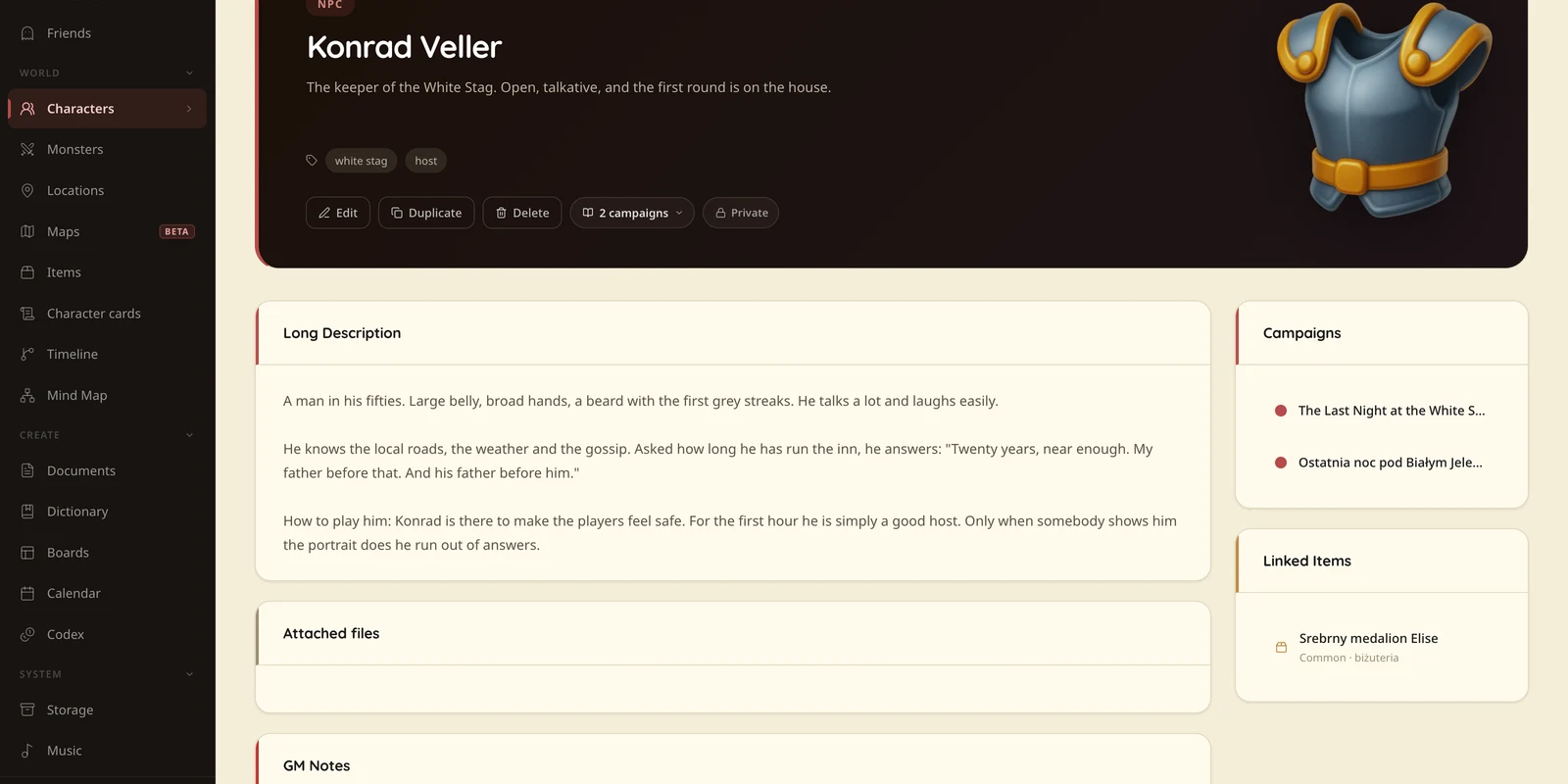
He talks easily and laughs often.
The first round is on the house because, as he puts it, "Anyone wet down to their underwear has suffered enough without me taking their money too."
Konrad knows the road, the area and local gossip.
If asked how long he has run the White Stag, he says around twenty years. Before him, his father did. Before that, his grandfather.
This is not true.
Konrad is not lying.
Elise Veller
Konrad's wife. A few years younger, quieter and more observant.
She runs the kitchen and rooms.
She does not trust one of the guests but cannot explain why.
Every so often she touches a small silver medallion around her neck. If asked about it, she says it belonged to her mother.
On the back is a date from roughly twenty-seven years ago.
Oskar Renn, merchant
Wet, irritated and mainly interested in whether the road will be passable tomorrow.
He carries a chest of cloth and two small cases.
He has no secret.
Really.
Not every person in an RPG scenario needs to be a cultist wearing a normal person as a disguise.
Oskar complains, bargains over the room price and eats more roast than he should.
He is useful because he is ordinary.
Lotte Eber
A woman in her forties travelling alone.
She says she is visiting her daughter, who recently had her first child. In her bag is a small wooden horse for her grandson.
She is warm, practical and easy to talk to.
Remember the wooden horse.
It may matter later.
Friedrich Saal
A former soldier who dislikes talking about the war but enjoys dice.
His right knee causes him trouble. He says he will head south tomorrow to look for work.
If a character sits with him, he offers a game.
He does not cheat.
He loses cheerfully.
Ada and Martin Heller
A young married couple travelling to a new home.
They have too much luggage and too little money.
They argue over small things and make up five minutes later.
You can effectively run them as one NPC.
The important thing is that the players see them together.
Let a normal evening happen
Give it twenty minutes.
Maybe forty.
Do not rush.
Konrad brings food.
Someone opens another bottle.
Friedrich invites the characters to play.
Lotte asks where they came from.
Oskar complains about the weather.
Ada and Martin argue about who was supposed to watch the bag of apples.
Maybe someone helps in the stable. Maybe a character flirts. Maybe the party is tired and immediately goes upstairs.
All fine.
You only need the White Stag to become a real place for a little while.
Then start breaking details.
Not reality.
Details.
The first thing that does not fit
On the frame of one bed, somebody scratched a message.
The character may notice while putting down a weapon, moving a candle or looking under the bed.
There is a date.
The same date engraved on Elise's medallion.
Underneath are three words:
DO NOT OPEN THE DOOR
If they ask Elise, she shrugs.
She does not know who wrote it. The medallion belonged to her mother. She thinks the date may have been her mother's wedding day.
She is not sure.
Nothing else happens.
Yet.
The portrait
Three old paintings hang in the common room.
A forest.
A hunt.
A group of people standing in front of the White Stag.
The portrait can be there from the beginning. Nobody pays much attention until a character looks carefully.
Konrad is in the painting.
A little younger, perhaps.
Beside him stand Elise, Friedrich, Lotte, Oskar, Ada and Martin.
Exactly the people sitting in the inn tonight.
The painting is dated twenty-seven years ago.
If shown the portrait, Konrad stares at it for a moment.
Then he laughs.
Good likenesses, aren't they?
If pushed, the laugh disappears.
He genuinely has no explanation.
They cannot remember
From this point, let the players ask specific questions.
The more precise the question, the worse it becomes.
Lotte is visiting her daughter.
What is her daughter's name?
Anna. No. Maria. I think Maria.
Where does she live?
Lotte points north.
A minute later she says south.
Friedrich fought in a war.
Which war?
He cannot remember.
Oskar carries cloth.
Where from?
He looks at the chest for too long.
Ada and Martin are married.
Martin cannot remember his father's surname.
Ada cannot remember which city they were married in.
These people are not hiding information.
They are frightened.
Then somebody knocks
It is late.
The rain is still falling.
Somebody knocks on the front door three times.
Konrad goes pale immediately, though he does not know why.
Elise drops her cup.
Friedrich stands and says:
Don't open it.
He does not know how he knows those words.
The knocking comes again.
Three times.
If the characters look through a window, nobody is there.
If they open the door, a boy stands outside.
Around twelve years old.
Soaked.
Barefoot.
Holding a lantern.
He looks at Konrad.
This time you have to leave.
What really happened at the White Stag
Twenty-seven years ago, the inn burned down.
Seven people died in the fire:
Konrad. Elise. Oskar. Lotte. Friedrich. Ada. Martin.
They died on the exact night the characters are currently experiencing.
But the White Stag is not simply a haunted house.
That would be too easy.
Something about that night is incomplete.
The boy
His name is Emil.
He was the son of Konrad and Elise.
The characters have seen none of his belongings. His parents never mentioned having a child. He is not in the portrait.
But he existed.
That night, Emil noticed the fire first. He woke his parents and ran outside.
Then he went back into the inn.
He never came out.
That is the gap.
Not the fire itself.
The moment just before it.
History remembered the night incorrectly
Seven bodies were found after the fire.
Not eight.
Emil's body was never recovered.
Some people later claimed to have seen a boy near the road. Others said he had run away. Years passed and nobody was sure Konrad Veller had ever had a son.
Eventually Emil disappeared from documents, stories and memory.
As if history itself had cut him out.
But the night remembers him.
That is why, once every few years, the White Stag returns and recreates the same evening again.
It is not trying to frighten travellers.
It is trying to finish something.
This time the player characters are there.
What caused the fire?
Use whatever fits your setting, but the simplest answer is often best.
It was not a curse.
Not a cult.
Not a demon crawling out of the floor.
A lamp fell in the cellar.
The flame caught a barrel of alcohol, then the beams.
People panicked.
Sometimes tragedy does not need dark magic.
The supernatural part came afterwards.
Emil wants to save his mother
Not everyone.
Elise.
That is why he went back inside.
The medallion Elise wears actually belonged to Emil. Earlier that evening, she gave it to him and told him to "look after the family."
He returned for her.
He failed.
For twenty-seven years, the White Stag has been trying to complete that moment.
But changing it creates another problem.
History only knows the version where everyone died.
Lotte never visited her daughter.
Friedrich never found work.
Ada and Martin never reached their new home.
Konrad and Elise never saw another morning.
If they survive now, the world needs to make room for them.
Nobody knows what that means.
At this point the scenario stops being a mystery.
It becomes a decision.
The fire
Let the characters smell smoke when they think they finally understand what is happening.
A scream comes from the kitchen.
Fire begins to spread.
From this moment, stop giving them unlimited time to discuss.
A beam cracks.
Smoke fills the corridor.
The horses panic.
Someone is upstairs.
Someone returns for luggage.
Someone tries to fight the flames.
The players can save people.
Maybe all of them.
But it should require action.
Do not throw a horde of enemies at them.
The fire is the fight.
If your system likes mechanics, run it as a series of simple escalating challenges. Each round makes the situation worse.
Failure does not always need to mean hit point damage.
It can mean lost time, a collapsed corridor or an NPC cut off from the exit.
The important resource is time.
What about Emil?
When the fire reaches the upper floor, Emil goes after Elise.
Exactly as he did twenty-seven years ago.
The characters can stop him.
They can follow him.
They can save Elise themselves.
They can decide history should not be changed.
Do not tell them which answer is correct.
If they save Elise
They make it outside.
Rain begins beating down the flames.
Elise holds Emil. Konrad kneels beside them. The other survivors stand in the mud.
For a moment, everything is fine.
Then Emil begins to fade.
Not dramatically.
His clothes grow pale first.
Then his face.
Elise tries to hold him.
The boy looks at her.
Now you remember.
And disappears.
Elise cries.
Not because she has just lost her son.
Because she has just remembered that she ever had one.
Morning
The characters wake beside the road.
There is no inn.
No ruins.
No blackened foundation.
Only grass, wet earth and trees.
The horses are nearby.
All their equipment is there.
Almost all.
One character still has the key to their room.
The metal tag says:
WHITE STAG, ROOM 4
A merchant wagon arrives.
The driver stops when he sees people sleeping by the road.
If asked about the inn, he looks confused.
The White Stag?
A pause.
The one that burned down?
Yes.
Twenty-seven years ago.
You can end there.
Or give the players one small confirmation later.
A workshop sign in the next town:
Heller & Sons, Carpentry. Established 2503.
The owner explains that the business was founded by his grandparents, Ada and Martin Heller, after they survived a fire at a roadside inn on the way to their new home.
Something changed.
The world remembered.
If they save nobody
That is also an ending.
The White Stag burns.
History repeats.
In the morning the characters wake beside the road with the key and no inn.
Everything is as it was.
Almost.
One character finds a silver medallion in their pocket.
Inside is a tiny portrait of a boy.
Emil.
Somebody remembers him now.
Maybe that was enough.
Using the White Stag in your own campaign
Do not announce it.
No rumours about a haunted inn.
No quest to investigate a mysterious tavern that appears once every twenty-seven years.
Let it rain.
Let the characters be tired.
Let them see the light.
That is enough.
The White Stag works best between larger adventures, while the party is simply travelling from one place to another.
The players may not even notice the moment the scenario begins.
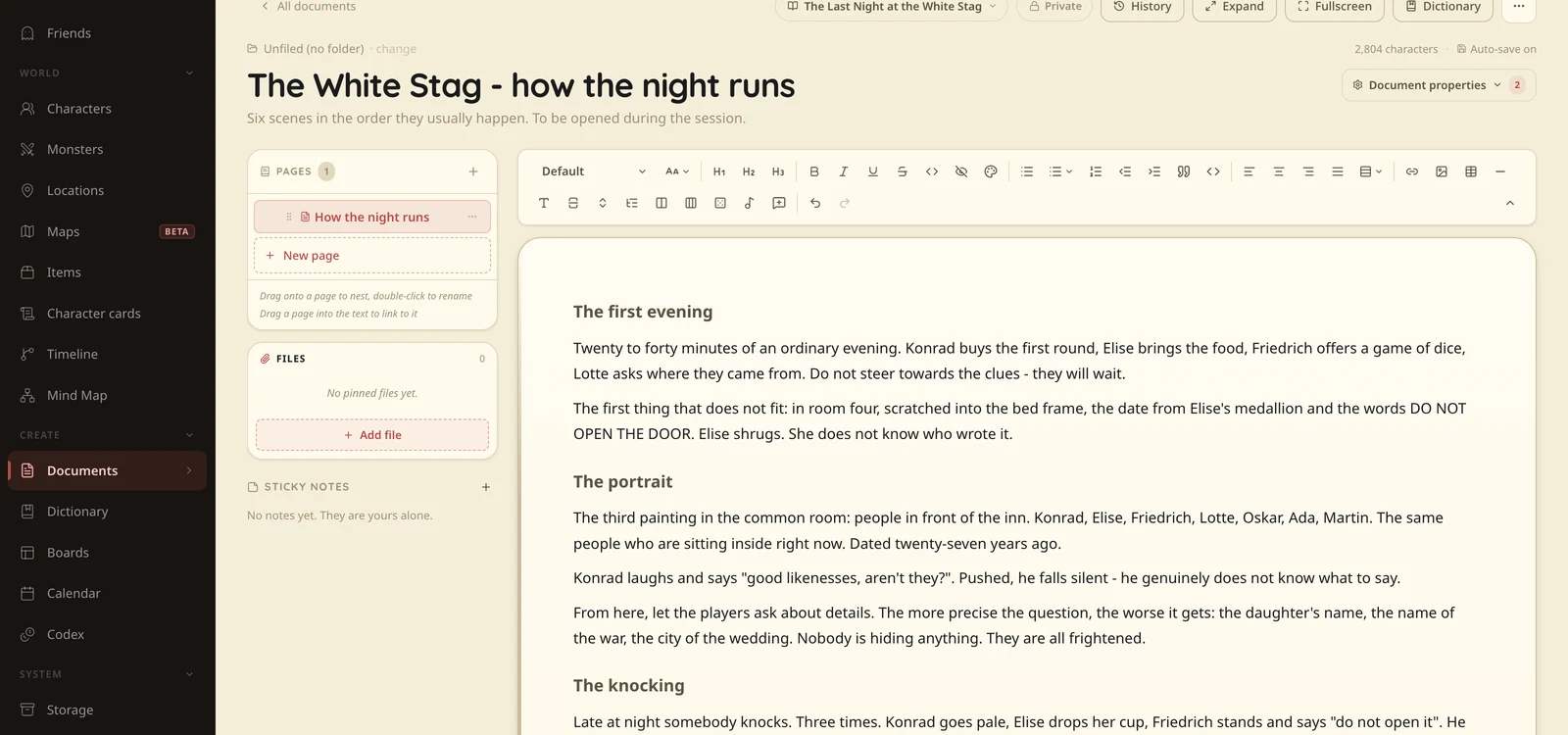
Before the game, prepare Konrad and Elise, a handful of other guests, Emil, a simple inn plan, the portrait, the medallion, a few strange events and the fire. If you keep your campaign in Talehaven, the inn works well as a location with the guests linked to it.
That is enough for an evening.
If what we are building is useful to you, you can buy us a coffee.
Support on Ko-fiKeep one campaign in one place
Documents, NPCs, locations, maps and music next to each other - so the session does not start with a search.
Try Talehaven