
Game Master Notes: How Not to Lose Track of Your Own Campaign
The Talehaven team9 min read
At the beginning of a campaign, everything feels simple.
You have a few NPCs, two locations, the main plot and a couple of ideas written down somewhere.
Then ten sessions go by.
The innkeeper from the first session turns out to be an informant. The players become attached to an NPC you planned to use once. Somebody promised a favour to a priest three months ago. The party found a key whose purpose is still unknown, and in the meantime you changed your idea for the main antagonist three times.
Suddenly the problem is no longer coming up with the campaign.
The problem is remembering what actually happened at the table.
Good GM notes should not document everything.
Their main job is to help you recover context quickly.
Do not write down every single thing
One of the easiest ways to create more work for yourself is trying to record everything.
The players talked to a merchant, then went to the tavern, then there was a fight, then they spoke to a guard...
After a few sessions, you have several pages of notes and still cannot quickly answer one simple question:
What was that guard's name, and why did the party have a problem with him?
Session notes should focus on things that may matter later.
It is usually worth recording:
- important player decisions,
- new information discovered by the party,
- promises and obligations,
- changes in relationships with NPCs,
- items gained or lost,
- open plot threads,
- consequences of the players' actions.
If the party spent twenty minutes negotiating the price of a horse, you probably do not need a full transcript.
If they insulted the son of a local noble during those negotiations, that may be worth remembering.
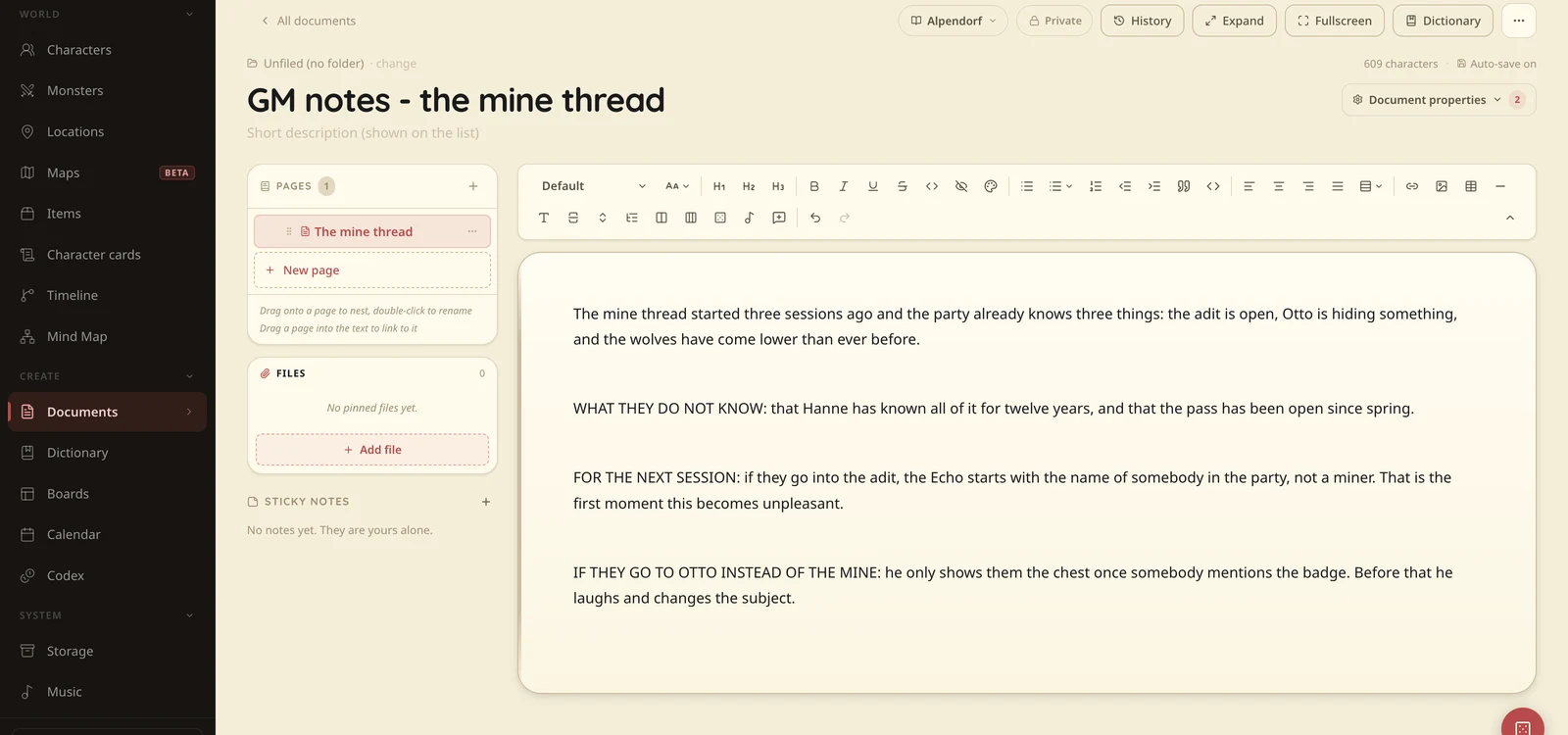
Your campaign needs one source of truth
Problems start when some information lives in the scenario document, some in a notebook, NPCs in another file, the map somewhere else and several ideas are still buried in a message you sent yourself weeks ago.
For a short adventure, you can survive that.
For a campaign lasting ten, twenty or fifty sessions, it becomes much harder.
This does not mean everything should live on one enormous page.
Quite the opposite.
Every type of information should have a place.
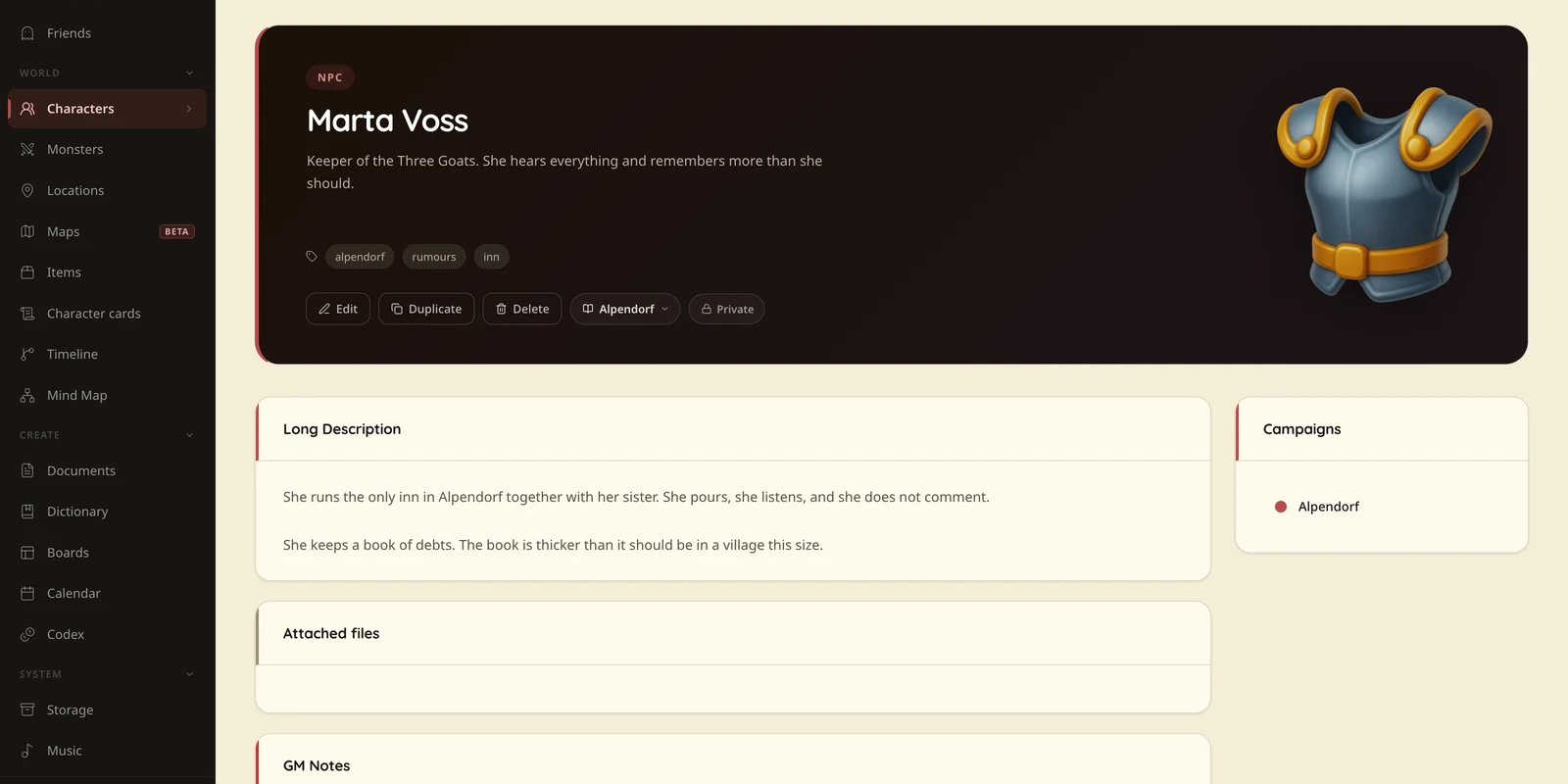
An NPC should be an NPC.
A location should be a location.
An item should be an item.
Session notes should describe what happened instead of duplicating every detail about every person and place involved.
When something changes, update it once.
If the captain of the guard loses an eye during session five, you should not need to wonder whether you corrected the description in three different documents.
Organise notes around what you will actually search for
It is natural to organise everything by session:
Session 1.
Session 2.
Session 3.
That is useful as a campaign journal, but it is not always the best structure for running the game.
During a session, you are much more likely to ask:
What was the innkeeper's name?
What does the party know about the cult?
Who controls this district now?
Where did they get that medallion?
That is why important parts of the world should also exist separately from chronological session notes.
An NPC can contain their current relationship with the party.
A location can hold information already discovered by the players.
An organisation can contain its members and goals.
An item can record its origin and current owner.
In Talehaven, NPCs, locations, items, documents, maps and events can exist as separate parts of the campaign.
The session note does not need to store the whole world.
It only needs to lead you back to the things it mentions.
Update important changes after the session
You do not need a three-page report after every game.
A few minutes is usually enough.
Ask yourself:
What important things happened?
What did the players change?
What new threads appeared?
Which old threads were resolved?
Who may react to what the party did?
That last question is particularly useful.
Players remember their actions.
The GM also needs to remember the consequences.
If the party robbed a merchant, the scene may have ended for the players when they left the shop.
For the campaign, it may only be beginning.
A note like:
> The merchant recognised Roderick. He may report the theft to the city guard.
is often more useful than half a page describing the entire scene.
Do not be afraid of open threads
Not every piece of information needs to lead immediately to a prepared storyline.
The players find a signet ring with a strange crest?
Write it down.
They hear the name of someone they have never met?
Write it down.
They get into an argument with a random guard?
Maybe that guard comes back later.
One of the biggest advantages of good notes is being able to return to these things several sessions later.
You do not need to know immediately what the signet ring means.
It is enough to know where it was found, who currently has it and what the players already know about it.
Later, when you need another clue or connection, you already have something that belongs to the world instead of introducing a completely new element from nowhere.
The campaign starts to feel more connected even if some of those connections were created after the fact.
A good note should help you in thirty seconds
There is a simple way to test whether your campaign notes are working.
Before the next session, try to find:
- the name of an NPC from five sessions ago,
- the last known location of an important enemy,
- an item acquired several sessions earlier,
- an unresolved plot thread,
- a secret the players have not discovered.
If every answer requires opening several documents and searching blindly, the problem is not your memory.
The problem is the structure of the notes.
This is one of the problems we are trying to solve with Talehaven.
A campaign does not need to be one giant document. It can be built from NPCs, locations, maps, items, timelines, documents and notes, connected so you can reach the information you need during play.
The goal is not to write more.
The goal is to make sure the things you already wrote down can actually be found later.
Because after twenty sessions, the biggest enemy of a Game Master does not always have to be the campaign's main villain.
Sometimes your own folder full of notes is enough.
If what we are building is useful to you, you can buy us a coffee.
Support on Ko-fiKeep one campaign in one place
Documents, NPCs, locations, maps and music next to each other - so the session does not start with a search.
Try Talehaven