
Most Game Masters have experienced some version of this. You prepare a location with considerable care, perhaps even commissioning a map or collecting reference images, only to discover that the party has very little interest in exploring it. They ask a few practical questions, speak to the person they came to meet, and leave without showing much curiosity about the impressive surroundings.
Then, during another session, you introduce a small tavern with a tired innkeeper, an unreliable fireplace, and a dog that growls whenever someone mentions the local magistrate. The players spend an hour talking to the regulars, return several sessions later, and eventually start treating the place as their unofficial headquarters.
It's tempting to conclude that players are simply unpredictable, which is certainly true. But there's something worth understanding about why particular places become important during a campaign.
A memorable RPG location isn't necessarily the most visually impressive, extensively described, or historically significant place in your setting. More often, it's somewhere the players have formed relationships, made decisions, and left a mark.
The difference becomes particularly obvious when the party returns.
A beautiful description isn't the same as a memorable place
Let's imagine two locations.
The first is a magnificent cathedral built during the reign of an ancient emperor. Its towers rise above the city, its marble floors are decorated with elaborate mosaics, and its walls contain inscriptions describing centuries of religious history. You've written several paragraphs about its architecture and carefully selected an illustration that captures the atmosphere.
The second is a small inn called the Crooked Lantern, standing beside a muddy road outside a mining town. The roof leaks, the food is acceptable when the cook is sober, and the owner has an unfortunate habit of charging extra whenever adventurers arrive with expensive equipment.
From a worldbuilding perspective, the cathedral is obviously more elaborate. But that doesn't necessarily make it more interesting to play in.
If the party visits the cathedral, listens to a description, speaks with a priest, and leaves, they may remember little beyond the fact that it was impressive. If they spend an evening at the Crooked Lantern arguing with the owner, helping a frightened traveler, and accidentally breaking a table during a disagreement with local miners, the inn has already become part of their story.
The difference isn't the quality of the description. It's the opportunity to interact with the place and the people who belong to it.
Players tend to remember what they did somewhere more clearly than everything they were told about it.
Give a location a reason to exist
One useful question to ask when preparing a location is what would happen there if the player characters never arrived.
The Crooked Lantern isn't simply a place where the party can purchase food, rest, and receive the next quest. It's a business struggling to survive during a difficult winter. The owner, Agnes Vale, is trying to keep the inn open after the closure of a nearby mine reduced the number of travelers passing through.
She employs a young cook who wants to leave the town, buys supplies from a merchant she doesn't particularly trust, and owes money to the local reeve.
Those details don't need extensive development. They're simply circumstances that give the location a place within the surrounding world.
When the party arrives, they encounter a situation that already exists. Agnes may be friendly because she needs customers, but she'll still insist on payment. The cook might ask whether the travelers know anyone hiring in the capital. A merchant could arrive demanding money at an inconvenient moment.
You don't need to turn every ordinary interaction into a quest. In fact, the inn will often feel more convincing if most of its problems remain fairly mundane.
What matters is that the place has its own identity, and that identity influences how people behave there.
The people often matter more than the building
When players become attached to a location, they're frequently becoming attached to the people associated with it.
A town becomes memorable because the party knows its inhabitants. A particular workshop matters because the blacksmith repaired their equipment after a difficult journey. A small shrine becomes important because the local priest helped one of the characters during a personal crisis.
Those relationships give locations meaning beyond their immediate function.
At the Crooked Lantern, Agnes might begin by treating the party like any other group of travelers. After a few visits, she remembers what they usually order and which rooms they prefer. She may also remember that the rogue still owes her money for a broken chair.
If the characters help her resolve a dispute with a supplier, her attitude changes. Perhaps she starts offering them better rates, or she simply stops assuming they're going to steal the silverware.
These are small developments, but they make returning to the location feel different from entering it for the first time.
The inn becomes somewhere the players have a history.
That history is much more valuable than another paragraph describing the furniture.
Let the players change things
One of the most effective ways to make a fictional location feel real is to allow it to respond to what the characters do.
Suppose the party discovers that the local reeve has been collecting illegal taxes from businesses along the road. They expose the scheme, and the reeve loses his position.
That decision should affect the Crooked Lantern. Agnes may finally have enough money to repair the roof. The cook might receive a raise, and travelers could begin returning to the area now that the road is safer.
Alternatively, perhaps the party handles the situation badly. They confront the reeve publicly, violence breaks out, and the inn suffers damage during the resulting unrest.
The location changes either way.
Players don't necessarily need to see the consequences immediately. In fact, discovering them several sessions later can be particularly satisfying.
Imagine the party returning to the Crooked Lantern after spending two months exploring distant ruins. The roof has been repaired, Agnes has hired another employee, and a small painted sign near the entrance thanks the adventurers who helped restore trade to the region.
That tells the players their actions mattered.
It also gives them a reason to feel connected to the place.
Revisiting a location should feel different
Recurring locations are useful because they give a campaign continuity. The players already know where they are, who lives there, and what happened during previous visits.
But familiarity becomes less interesting if nothing ever changes.
The innkeeper shouldn't repeat exactly the same conversation every time the party arrives, and the villagers shouldn't remain frozen in the circumstances of their first appearance.
You don't need to invent major developments between every session. A few small changes can be enough.
Perhaps the local hunter has returned from an expedition, the stablehand has taken on an apprentice, or a familiar customer has stopped visiting. Maybe the inn has acquired a new sign after the old one was damaged during a storm.
Some changes may be connected to the party's actions, while others happen independently.
That distinction matters. A fictional world feels more convincing when it continues to develop even when the player characters are somewhere else.
For a Game Master, the practical challenge is remembering what has changed. If the party returns after fifteen sessions, you need to know which NPCs are still present, what the characters previously did there, and which circumstances have developed since their last visit.
Keeping that information connected to the location makes it much easier to maintain continuity.
Interactive demo
The Crooked Lantern
One inn. Three visits. A place that remembers what the party did.
Session 01: First visit
A roadside inn outside a mining town that has stopped producing. Agnes Vale keeps it open out of stubbornness, charges adventurers extra on principle, and watches the door.
Help Agnes expose the illegal taxes
The inn is busier and Agnes trusts them, because the party removed the thing that was draining it.
The roof is mended. There are four horses in the stable instead of one, and the common room is loud enough that the party has to raise their voices. Agnes asks where they have been, and means it.
Ignore it and keep travelling
Nothing was done to it, so nothing stopped. The decline the party first saw simply continued.
Half the common room is shut off to save firewood. Agnes is civil and tired. She mentions, without making anything of it, that she has had an offer for the building.
Confront the reeve violently
The tax stopped, but the way it stopped is part of the inn’s history now, and of the party’s.
The window is glazed again and the yard is level. Trade has come back along the road, but not everyone in the village is glad to see the party, and Agnes still brings up the cost of the shutters roughly once a visit.
Secrets can make a place interesting, but they shouldn't be its only purpose
The Crooked Lantern could have a hidden cellar, a smuggling tunnel, or an old crime buried in its history. Those are perfectly reasonable ingredients for an adventure.
But the inn doesn't need a supernatural secret to be worth remembering.
Sometimes a place becomes important because it's safe, familiar, or emotionally significant to the characters. It might be where the party first met, where they celebrated surviving a difficult expedition, or where one of them made a promise they haven't yet fulfilled.
Adding a dramatic secret to every location can eventually make the setting feel artificial. If every tavern conceals a cult and every shopkeeper is secretly working for the villain, players may begin approaching ordinary conversations as investigations.
It's useful to let some places remain ordinary.
You can still introduce complications when they make sense, but those complications should grow from the people and circumstances you've established rather than appearing because the location needs something exciting to happen.
Not every memorable place has to become a dungeon.
Build locations around what players can discover and affect
When preparing a new location, try thinking about it in terms of interaction rather than description alone.
For the Crooked Lantern, you might begin with a short arrival description, the people who regularly spend time there, and the problems affecting the business.
Then consider what the party can learn through conversation or observation. Perhaps Agnes knows which merchants have recently stopped using the road. The cook may have overheard an argument involving the local reeve, while a regular customer remembers when the nearby mine was still operating.
Finally, think about what the characters could change.
Could they help Agnes keep the inn open? Might they become involved in a dispute between the miners and the town authorities? Could their actions make the Crooked Lantern safer, more prosperous, or considerably worse?
Those possibilities give the location something to offer during play without requiring a detailed sequence of prepared scenes.
You don't need to know exactly which direction the party will take. You need enough information to respond when they decide to involve themselves.
Keep the location and its relationships together
As a campaign grows, recurring places accumulate information.
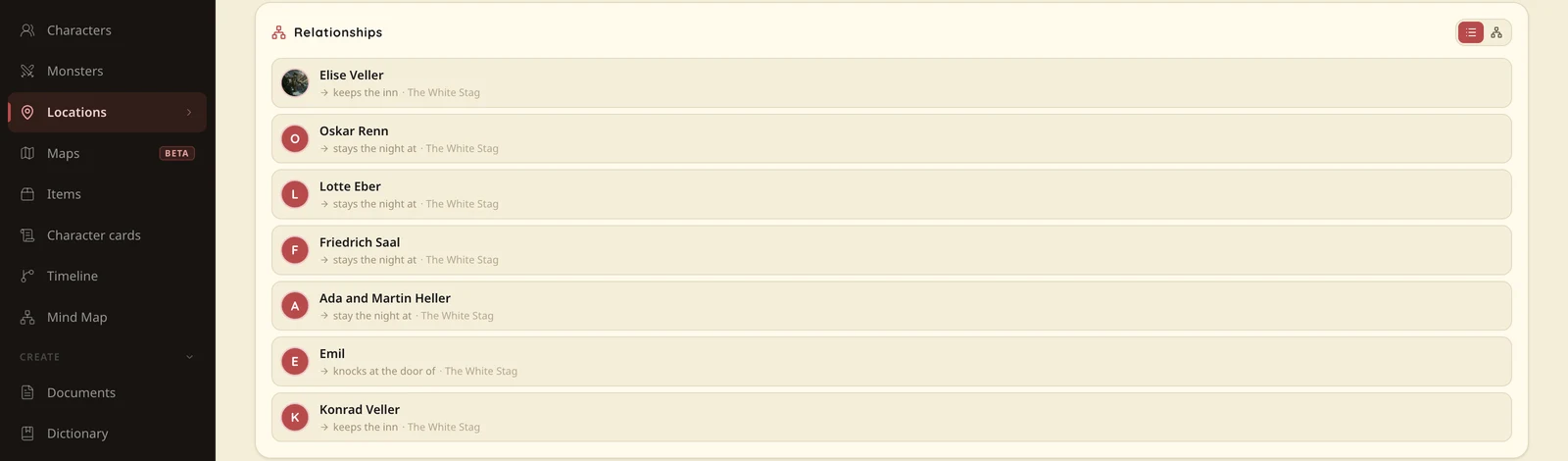
The Crooked Lantern now has an owner, several regular customers, an outstanding debt, a history with the player characters, and perhaps a few items or documents associated with events that happened there.
Keeping those details in separate session notes can become awkward. You remember that Agnes mentioned the reeve's nephew several months ago, but you can't remember which document contains the conversation.
This is where organizing locations as connected campaign elements becomes useful.
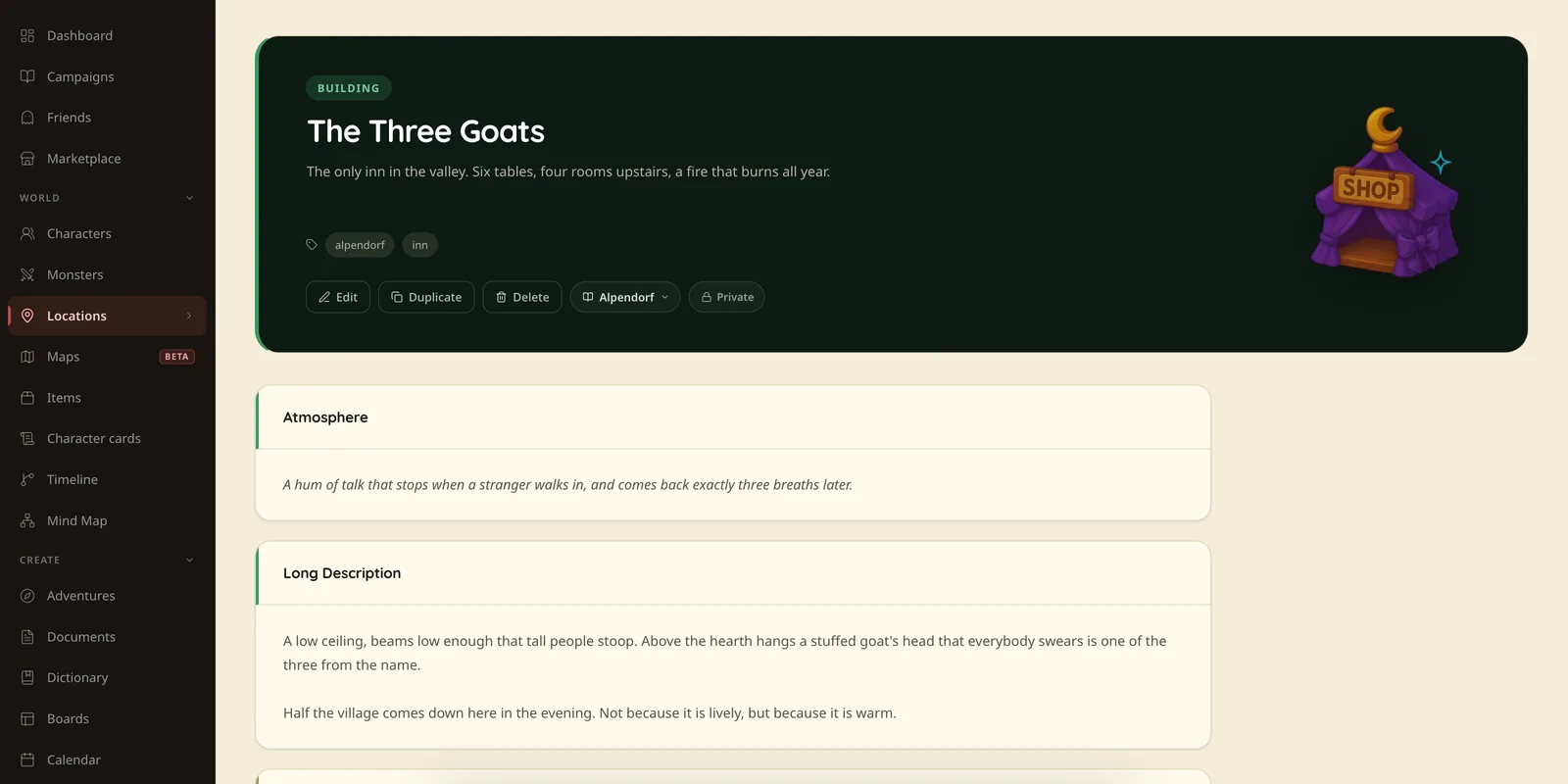
In Talehaven, a location can have its own description and supporting material, with related NPCs, items, maps, and notes accessible alongside it. You can develop the location as the campaign progresses instead of repeatedly recreating its description whenever the party returns.
Boards are also useful when a location becomes part of a larger network of relationships. You might want to visualize connections between the inn, nearby mine, merchant guild, local authorities, and characters involved in those organizations.
The purpose isn't to create an elaborate database for every village the party visits. A roadside inn that appears once probably doesn't need the same level of detail as the city where the campaign has been taking place for a year.
Start with what you need. Add more when the players give you a reason.
A location can become the party's home without you planning it
One of the nicest developments in a long campaign is when the players begin treating a place as their own.
They may purchase a building, establish a headquarters, or simply return to the same tavern whenever they're in the area. Over time, they develop routines and relationships that exist alongside the main adventure.
Perhaps the party always sits at the same table in the Crooked Lantern. They know which food to avoid, which regulars are worth speaking to, and how to persuade Agnes to keep the kitchen open after midnight.
They might leave equipment there between expeditions, help fund repairs, or invite an old companion to stay when that character retires from adventuring.
None of this necessarily advances the main plot, but it gives the campaign something valuable: a sense of belonging.
And once the characters have somewhere they care about, events affecting that place can carry real emotional weight without requiring artificial drama.
A threat to the Crooked Lantern matters because the players have built a relationship with it, not because you've announced that the fate of the world depends on its survival.
What should you prepare before introducing a new location?
You don't need an enormous template. For most locations, a few practical questions are enough.
- What happens here when the party isn't around? Give the place a function and circumstances that exist independently of the adventure.
- Who makes the place interesting? Identify one or two people whose behavior and motivations help establish its character.
- What can the players discover? Think about information, relationships, objects, or opportunities that might become relevant through interaction.
- What could they change? Consider how their decisions might affect the location, its inhabitants, or its future.
- What should be different when they return? You don't need to decide everything in advance, but keeping track of changes creates continuity across sessions.
These questions are useful whether you're preparing a tavern, ruined temple, space station, frontier settlement, or entire city district.
The scale changes. The underlying principle doesn't.
The places players remember are the places where something mattered
It's tempting to measure worldbuilding by how much detail we've created. We count the locations on a map, the pages of history we've written, and the number of people living in our fictional cities.
But the players experience those worlds differently.
They remember the workshop where someone helped them when they were desperate, the village they saved from a terrible winter, and the inn where they celebrated after surviving an adventure that nearly killed them.
The Crooked Lantern may never be the most impressive building in your campaign. Its roof still leaks occasionally, Agnes still complains about the price of supplies, and the cook continues threatening to leave for the capital.
But if the party returns after months away and asks how everyone has been doing, you've probably created a place that matters to them.
You don't need to add another secret chamber or ancient prophecy to make it more interesting.
Sometimes the best thing you can do is let the place remember what happened there.