
There's a peculiar injustice in being a Game Master. You can spend an entire evening developing a major character, carefully considering their motivations, secrets, relationships, and role in the campaign. You might even practice their voice on the drive to the session, which is perfectly normal behavior and certainly nothing to be embarrassed about.
Then the players meet a stablehand you invented fifteen seconds ago, and for reasons nobody can adequately explain, they decide he's the most interesting person in the setting.
Suddenly they're asking about his family, offering to help repair the stables, and trying to recruit him for an expedition into the mountains. At least one player has already decided that anyone who threatens this man will become their personal enemy.
You barely remember giving him a name.
If you've been running tabletop RPGs for a while, something similar has probably happened to you. It's one of the more entertaining consequences of letting players interact freely with a fictional world, and it can create some of the best material in a campaign.
It can also become surprisingly difficult to manage if you're not careful.
Why players get attached to characters you barely prepared
From behind the GM screen, certain characters obviously matter more than others. You know which noble is secretly financing the cult, which merchant possesses an important clue, and which apparently harmless traveler will eventually betray the party.
The players don't have that information. They meet people without knowing where those characters sit in your preparation notes, and they form opinions based on the interactions they actually experience.
An important NPC may arrive with a carefully written introduction and an obvious narrative purpose. A minor character, by contrast, can feel refreshingly ordinary. They aren't necessarily trying to recruit the party, explain the plot, or deliver information. They might simply be irritated because the adventurers have brought six muddy horses into a stable that was cleaned half an hour ago.
That kind of interaction can be memorable precisely because it doesn't appear to exist for the benefit of the story.
Players also tend to respond strongly to characters who acknowledge their actions. If a stablehand remembers that the fighter helped him repair a broken gate, or an innkeeper offers the party their usual table without being asked, the setting begins to feel like a place where relationships persist between adventures.
The character doesn't need to be remarkable. Sometimes being consistently, convincingly ordinary is enough.
Meet Walter, the least important man in the village
Let's imagine a small mountain settlement called Brackenford. The party arrives while investigating several disappearances near an abandoned mine, and you've prepared the usual collection of suspects, witnesses, and people with suspiciously detailed knowledge of local history.
The stablehand isn't one of them.
His name is Walter Fen, a widower in his late sixties who has spent most of his life looking after horses. He complains about the weather, dislikes the village reeve, and believes adventurers are generally too careless with animals. You improvise those details because one of the players asks whether anyone is available to look after their mounts.
During the conversation, Walter notices that the ranger's horse has a damaged hoof. He offers to treat it and makes an unflattering remark about the ranger's riding ability.
The table laughs. The ranger argues with him. Walter refuses to apologize, although he still treats the horse.
It's a small interaction, and you expect the party to leave the stables and continue investigating the mine.
Instead, they return the following morning to check on the horse. Someone brings Walter breakfast. Another character asks whether he remembers anything unusual about the villagers who disappeared.
You give him a little more personality. He knows the people who vanished, although he has no secret knowledge of what happened to them. One was his neighbor. Another owed him money for a saddle repair. He's worried about both, even if he expresses that concern mostly by complaining.
By the end of the session, Walter has become part of the party's experience of Brackenford. He wasn't designed to carry the story, but the players now have a reason to care about what happens to the village.
That's useful material. The question is what you do with it.
Let the relationship develop before you give the character a bigger role
When players become interested in an improvised NPC, it's tempting to reward that interest by making the character immediately important to the main plot.
Perhaps Walter secretly knows the villain. Maybe he once belonged to an ancient order of knights. Maybe he's actually a retired archmage living under an assumed identity.
You can certainly take the story in one of those directions, but there's a risk in doing it every time. If every likable background character turns out to possess a dramatic secret, the world starts to feel strangely artificial. Nobody can simply run a stable or sell bread without hiding an extraordinary past.
A more interesting approach is to let the relationship grow through ordinary interactions first.
Walter remembers the ranger's horse. He starts setting aside food for the party's animals when he expects them to return. He might ask them to deliver a letter to his daughter in the next town, not because the letter contains a secret code, but because he worries about her and doesn't trust the postal service.
Those details establish a connection without demanding that the entire campaign revolve around him.
If the characters help Walter, he may become more willing to help them. If they behave recklessly, he might criticize them. If they disappear for several weeks, he could reasonably wonder whether they're still alive.
The character becomes more interesting because the relationship has a history, not because you've suddenly promoted him to the main cast.
Give recurring NPCs lives that continue between sessions
One of the simplest ways to make an NPC feel real is to let their circumstances change when the players aren't watching.
Walter shouldn't spend three months standing beside the same horse, waiting for the party to return. Perhaps he hires an apprentice, repairs the roof of the stable, or has an argument with the reeve over an increase in local taxes.
None of these developments needs an elaborate subplot. They're ordinary things that might happen to someone running a business in a small village.
But when the players return to Brackenford, they'll notice that Walter's life has continued.
Walter FenFrom background NPC to recurring character
Session 01
The stablehand
A name, an occupation and one interaction nobody planned.
- Walter Fen, stablehand
- Complains about the weather
- Argued with the ranger about a horse
Session 04
A familiar face
Remembers the party, has an opinion about it, and asks for a small favour.
- Sets aside feed for the party’s horses
- Does not trust the reeve
- Asks them to carry a letter to his daughter
Session 09
Someone worth returning to
His circumstances have changed, and the players’ earlier decisions affected them.
- A new tax threatens the stable
- Has taken on an apprentice
- Owes the cleric a favour
You can use the same principle for other recurring characters. A merchant might expand their business, a guard could receive a promotion, or a local priest might gradually lose the confidence of the community. These changes give the setting continuity and allow relationships to develop naturally.
The useful preparation isn't a complete biography. It's an understanding of what the character wants, what they're currently dealing with, and how the party has affected their life.
For Walter, you might keep a short record of his relationship with the group: he respects the ranger's concern for animals, distrusts the rogue after discovering an unpaid stable bill, and appreciates that the cleric helped his apprentice recover from an illness.
That is enough to make the next meeting feel like a continuation of something rather than a fresh introduction.
Player attachment gives consequences more weight
There's a familiar technique in tabletop RPGs: introduce a likable character, let the players become attached, and then threaten or kill that character to demonstrate how dangerous the villain is.
It can work, but used carelessly it becomes predictable. Worse, it can teach players that caring about anyone in the setting is a mistake.
If every friendly innkeeper is murdered, every adopted animal disappears, and every beloved companion turns out to be a traitor, the party may eventually stop forming relationships altogether.
That's a shame, because those relationships are some of the best tools a Game Master has for making the world meaningful.
You don't need to hurt Walter to make his existence matter. The party might discover that the village is facing a harsh winter and that the stable will struggle to survive without trade from the mine. Perhaps the reeve introduces a new tax that threatens Walter's livelihood, or the road becomes dangerous enough that merchants stop visiting.
These are problems the players may choose to care about because they already care about the person affected.
And if they decide to intervene, their actions can have lasting consequences. Walter might be grateful, embarrassed, or even irritated if the party solves his problem in a way that creates trouble for other villagers.
A relationship becomes interesting when it creates choices, not merely when it provides a convenient target for the villain.
Sometimes a favorite NPC should remain a supporting character
There's another potential problem with unexpectedly popular NPCs: they can start consuming more table time than the adventure itself.
You may find the players spending an hour talking to Walter whenever they visit Brackenford. That can be entertaining, particularly if everyone enjoys the interaction, but it may eventually interfere with the rest of the campaign.
You don't have to stop the players from visiting him. You can simply give the conversation a natural shape.
Walter has work to do. He can't spend the entire afternoon discussing the party's theories about the mine. He might offer his opinion while checking the horses, then explain that he needs to finish repairing a wagon before sunset.
If the group wants a longer conversation, perhaps they'll arrange to meet him at the tavern later.
The NPC remains part of the world without becoming permanently available for unlimited interaction.
This also helps preserve the character's identity. Walter is interesting partly because he has his own priorities. If he abandons everything whenever the adventurers arrive, he begins to feel less like a person and more like an extension of the party.
Remember the details your players remember
The biggest practical challenge with improvised NPCs is continuity. You invent a character during one session, add a few details as the players interact with them, and then forget half of those details before the next game.
Unfortunately, your players may remember everything.
They remember that Walter's daughter lives in the capital, that he dislikes the reeve, and that he once mentioned an old military horse he cared for during a border conflict. Three sessions later, someone asks about that horse, and you realize the entire conversation has vanished from your memory.
The easiest solution is to record important details while they're still fresh. You don't need a transcript or a complete character sheet. A name, location, current goal, a few relationships, and a summary of what happened with the party are usually enough.
As the character becomes more important, you can expand that information.
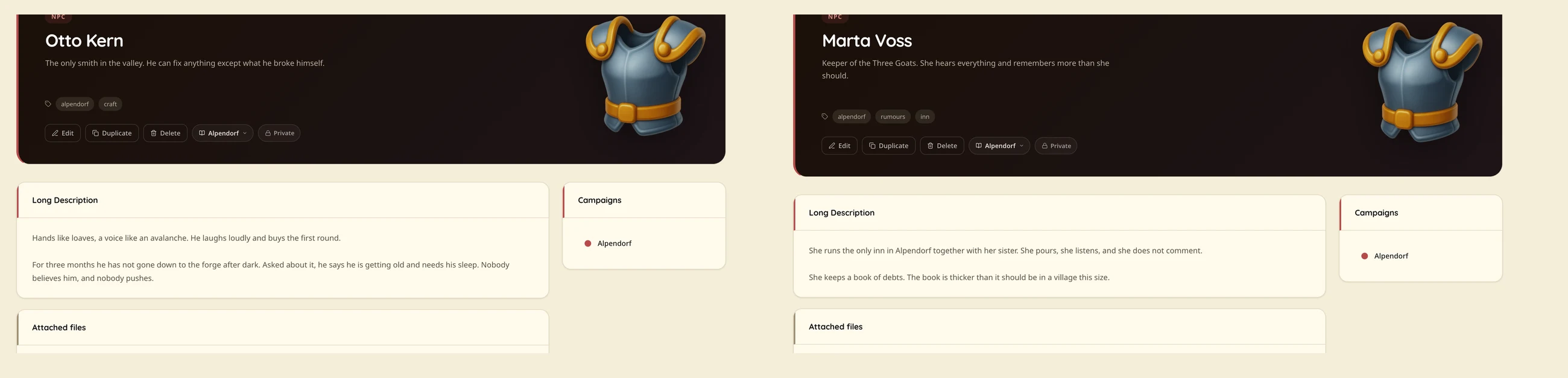
This is one of the situations we had in mind when building Talehaven's NPC tools. A character can begin as a simple entry and develop over time, with additional details, relationships, items, and private GM notes added when they're needed. You can also keep NPCs connected to locations and other campaign elements, so returning to Brackenford doesn't require remembering which document contained Walter's latest appearance.
A visual Board can help when those relationships become more complicated, especially if the party has developed ties to several people or factions within the same settlement.
The aim isn't to document every word the NPC has spoken. It's to preserve enough continuity that the next interaction makes sense.
Don't take ownership of the relationship away from the players
One reason unexpected NPCs become popular is that the players feel they discovered them. They weren't necessarily introduced through a dramatic cutscene or presented as an obviously important ally. The party chose to interact with them, and something about that interaction worked.
It's worth respecting that.
You can develop the character, give them problems, and allow them to influence the story, but you don't need to decide in advance exactly how the relationship should evolve.
Maybe the players eventually recruit Walter to manage the stables at their newly acquired headquarters. Perhaps they help him retire comfortably, or maybe he refuses to leave Brackenford because his entire life is there.
He might even end up disliking the party after they make a decision he strongly disagrees with.
Whatever happens, the relationship should be allowed to change through play.
That's part of what makes tabletop RPGs different from stories where every character's role is determined before the audience meets them. A seemingly unimportant person can become central to the experience because the players decide that they matter.
The characters you didn't plan are still part of the story
Not every memorable NPC needs a dramatic entrance, a distinctive accent, or several pages of background information. Sometimes a character becomes important because they were kind to the party at the right moment, challenged someone in an amusing way, or simply behaved like a believable person.
You can't reliably predict which characters your players will love. That's probably a good thing.
What you can do is notice when a connection forms, remember what makes that relationship interesting, and allow the character to develop without forcing them into a role they don't need.
Walter may never become a great hero, a secret villain, or the key to solving the mystery beneath Brackenford. He might remain an elderly stablehand who worries about his daughter, argues with the reeve, and insists that the ranger still doesn't know how to look after a horse.
And if the party returns to visit him every time they pass through the village, you've probably created someone worth keeping around.
Not bad for a character who wasn't supposed to have a name.