
Every Game Master has their own way of preparing a session. Some write detailed scenarios with carefully numbered scenes, others keep a notebook full of names and half-finished ideas, and a few can somehow run an entire evening from three bullet points and a map drawn on a napkin. Most of us fall somewhere in between, gradually collecting documents, character descriptions, maps, illustrations, and notes until the material for a relatively simple adventure starts looking like the archive of a small government department.
None of those methods is inherently wrong. A Google Doc can hold a perfectly good adventure, and a notebook can serve a GM for decades. The trouble usually begins when you try to use all that material during an actual session. Your players are talking to an NPC who wasn't supposed to be important, someone asks about an item from four sessions ago, and the map you need is apparently in a folder called "Campaign Final 3."
At that moment, you aren't really preparing or running an adventure anymore. You're managing information.
We've been thinking about that problem while building Talehaven, particularly about the difference between writing an adventure and having everything you need to run it. Our Adventure and Board modules are two parts of the same idea: give the GM a way to organize scenes and information without forcing everything into a long document or a rigid sequence of events.
And perhaps more importantly, make the whole process enjoyable.
An adventure doesn't always fit neatly into a document
Think about how you actually imagine a tabletop RPG adventure.
Perhaps it starts with an abandoned mining settlement. You can picture the narrow streets, the tavern where the remaining workers gather, and the entrance to a mine nobody has entered since the last collapse. There's a foreman who knows more than he's admitting, a blacksmith with a missing brother, and something moving beneath the mountain.
You probably don't imagine all of this as twelve pages of text.
You imagine people, places, situations, and connections between them. You know that the blacksmith's brother disappeared near the mine, that the foreman has been hiding a journal, and that the players might discover either clue depending on whom they speak to first.
Of course, you can write all of that down. Most of us have been doing exactly that for years. But a document gives the information an order, and the players have a remarkable talent for ignoring whatever order you had in mind.
This is where visual preparation becomes interesting. Instead of treating the adventure exclusively as a sequence of paragraphs, you can arrange its individual pieces in a way that lets you see how they relate to one another.
That's what we've been exploring with Talehaven.
Meet the Adventure module: Scenes with everything they need
The Adventure module gives you a place to build the situations your players might encounter. You can divide an adventure into acts or sections using Walls, create individual scenes, and place the relevant information directly inside them.
A scene can contain descriptive text, images, notes, maps, characters, and other materials. You can keep information intended for players separate from the details that should remain behind the GM screen.
Let's return to our mining village.
You create a scene called The Last Night at the Forge. It contains a short description of the workshop, the blacksmith's character information, a letter found beneath an unfinished suit of armor, and the map of the nearby streets. You also include a private note explaining why the blacksmith becomes nervous whenever someone mentions the mine.
Everything relevant to that encounter is close at hand.
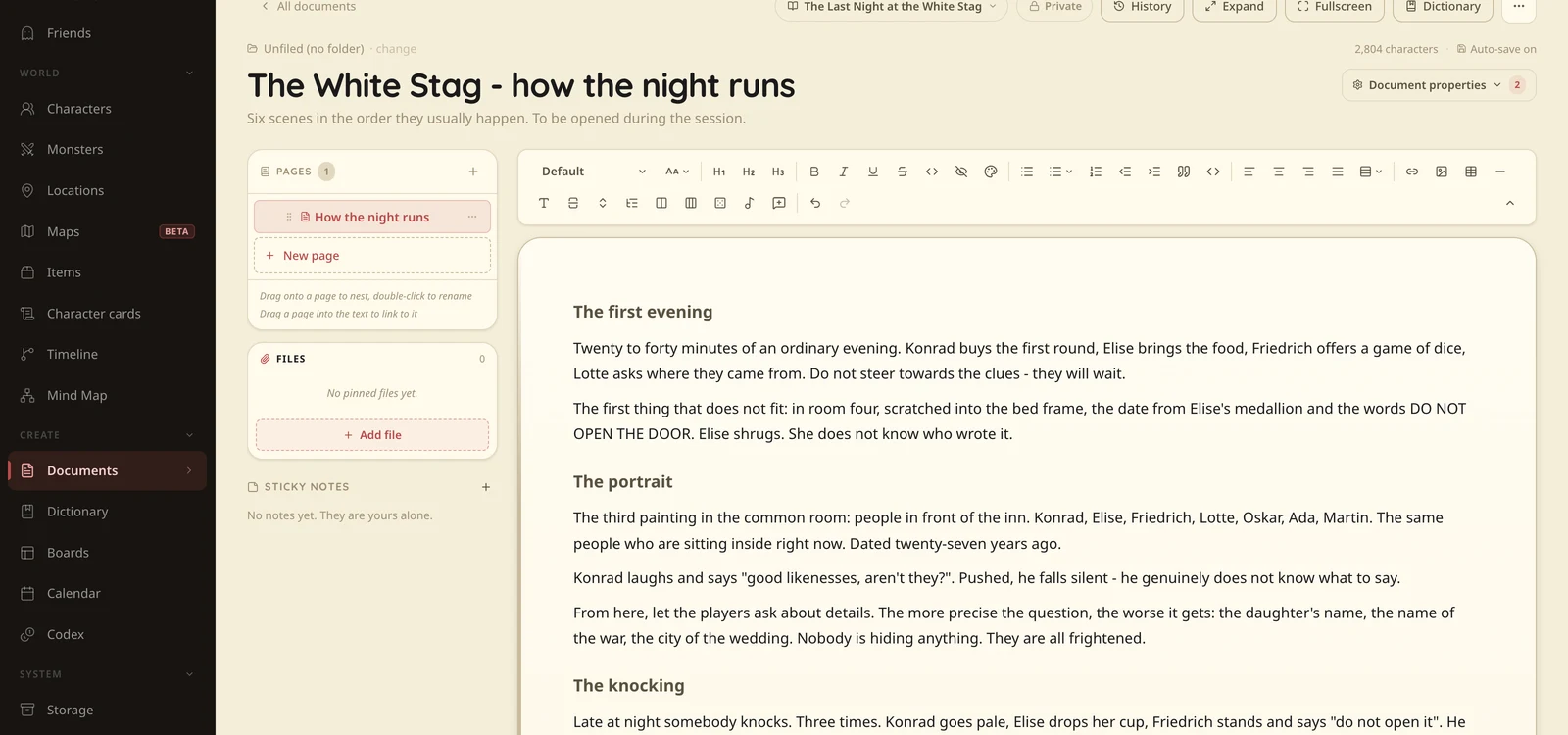
If the players visit the forge, you open the scene and run it. If they decide to investigate the mine first, you open the appropriate scene instead. You're not trying to force the players through a predetermined sequence simply because that's how you arranged the notes.
The same NPC, location, or item can be used across different scenes without recreating its entire description. If a character changes over the course of the campaign, you can work with the existing campaign entry rather than maintaining several copies scattered through separate documents.
That sounds like a small organizational detail, but anyone who has run a long campaign knows how useful it can be.
The Adventure module provides structure without demanding that every session follow a script.
Now put those ideas on a Board
Some parts of an adventure are easier to understand when you can actually see them.
Perhaps the foreman is secretly supplying an illegal mining operation. The blacksmith suspects him but doesn't have proof, while the local priest knows that the strange noises beneath the mountain began long before the mine reopened. An old map connects the abandoned tunnels to a ruined shrine.
Written as a paragraph, that information is understandable. Spread across several documents, it becomes harder to follow. On a visual Board, however, you can arrange the characters, locations, clues, and relationships in front of you.
Talehaven's Board gives you a canvas for working with campaign material visually. You can bring related elements together, connect ideas, and organize the information according to what makes sense for the adventure you're creating.
It might look like a relationship map for a political conspiracy, a collection of locations and clues for an investigation, or a working area containing the material you need for an upcoming encounter. Not every adventure needs the same arrangement, and that's rather the point.
If you're preparing a mystery, you might focus on suspects and evidence. For a dungeon expedition, the important elements could be maps, encounters, environmental details, and the objects players may discover along the way.
You don't have to invent a complicated structure before you begin. Start with a few elements, move them around, and add connections as the adventure develops.
The Board isn't a geographical battle map, and it isn't supposed to be. It's a place to work with the adventure itself.
The interesting part is what happens when you bring both together
An Adventure and a Board solve slightly different problems. One provides a structured place for scenes and their materials, while the other gives you room to see the larger picture and work with connections.
But they become particularly useful when you can move naturally between those two ways of looking at the same adventure.
Talehaven allows an Adventure to be embedded on a Board as an interactive element. You can keep it alongside related NPCs, locations, illustrations, and notes, then open the Adventure in its workspace when you want to work on the scenes themselves.
Imagine preparing the final confrontation in our mining village. On your Board, you've arranged the mine entrance, the foreman's character, a map of the lower tunnels, and the journal containing the central clue. The Adventure sits alongside those elements, ready to open when you want to adjust the encounter.
You can look at the relationships, consider what might happen, and return to the actual scene without having to reconstruct your thinking from a collection of unrelated files.
For a GM who thinks visually, this can feel considerably more natural than jumping between a document, an image viewer, a character database, and a separate set of notes.
It also changes the feeling of preparation. You're not simply filling out fields or writing paragraphs. You're arranging the material for an evening of play, seeing what connects, and noticing possibilities you might have missed when everything was buried in text.
That's one of the things we're most excited about with this approach.
What happens when the players ignore your plans?
Let's say you've prepared three situations for tonight's game. The party is expected to speak with the blacksmith, investigate the abandoned mine, and eventually confront the foreman.
Ten minutes into the session, they decide the village priest is suspicious and spend the next hour trying to break into the chapel.
Naturally.
A rigid adventure structure can make this frustrating, especially if the information needed for that unexpected direction is buried inside the description of a completely different scene.
But if you've organized your material around characters, places, and situations, you have more freedom to respond. The priest already has a character entry, the chapel exists as a location, and the connections on your Board remind you that the priest knows something about the ruined shrine beneath the mountain.
You don't need to invent an entirely new plot. You can use the material you've already prepared in a different order.
Of course, no application can do the actual improvisation for you. It can't know what your players will ask or decide how a frightened priest should react when confronted by an unusually persuasive barbarian.
That's still your job, and frankly, it's one of the best parts of being a GM.
What the tools can do is help you find the right information quickly enough that the conversation never has to stop.
You don't need to become a project manager to prepare a session
Whenever a new RPG tool appears, there's a reasonable concern: will using it become another hobby that takes time away from playing?
We've all seen elaborate campaign databases, carefully color-coded documents, and organizational systems that look impressive but require more maintenance than the campaign itself.
Talehaven isn't meant to turn every Game Master into a project manager.
You can start with one adventure, create a couple of scenes, add the people your players are likely to meet, and place the important materials on a Board. You don't need a hundred NPCs, a complete world encyclopedia, or every possible branch of the story worked out in advance.
If you're preparing a four-hour one-shot, that's perfectly fine. The same tools can support a larger campaign later, but there's no reason to build that entire structure before your first session.
And if you prefer to keep some things on paper, there's nothing stopping you. A digital workspace should support the way you like to run games, not dictate it.
The idea is to make preparation easier to work with, both before the session and while everyone is sitting around the table.
Try preparing your next adventure differently
Here's a small experiment you can try with your next session.
Pick something small
Take an adventure you haven't fully prepared yet. It doesn't need to be complicated. A missing merchant, a haunted inn, a ruined watchtower, or a village with a problem nobody wants to discuss will do.
Create the adventure and a few scenes
Give it three or four possible scenes. Add the NPCs and locations you know you'll need, then attach the relevant materials to those scenes.
Arrange the important elements on a Board
Put related characters near each other, connect the clues that matter, and keep the maps or illustrations where they'll be useful. Add the Adventure to your Board so you can move between the overall picture and the individual scenes.
Look at what you have prepared
Can the players approach the problem in a different order? Do the NPCs have motivations that still make sense if an expected scene never happens? Is the information you need during play easy to reach?
Those questions matter more than the number of pages you've written.
When the session begins, use the structure as a reference rather than a set of instructions the players must follow.
You may discover that you enjoy preparing adventures this way. You may also decide that some parts of your existing process still work better on paper. Either outcome is useful, because the aim is to find a way of working that fits your table.
A different way to think about RPG preparation
We've been writing and running tabletop RPG adventures for a long time, and we're certainly not going to pretend that a digital Board has suddenly made notebooks obsolete. There are good reasons people still use paper, plain text files, and familiar tools they've customized over the years.
But we do think there's room for a different approach.
An adventure isn't just a document. It's a collection of situations, characters, locations, choices, and consequences that begin interacting once the players sit down.
Preparing those elements visually, while keeping the actual scenes and their materials close at hand, feels like a natural way to work with that complexity. It gives you structure when you need it and flexibility when the players inevitably do something you hadn't anticipated.
That's the direction we're taking with Talehaven's Adventure and Board modules.
And the best way to understand it is to try building a small adventure yourself.
You don't need to move your entire campaign or spend a weekend setting up a new system. Start with a handful of scenes, a few characters, and one Board. See how it feels when the material for your next session is arranged in front of you rather than scattered across a dozen files.
Your next adventure is a good place to start.